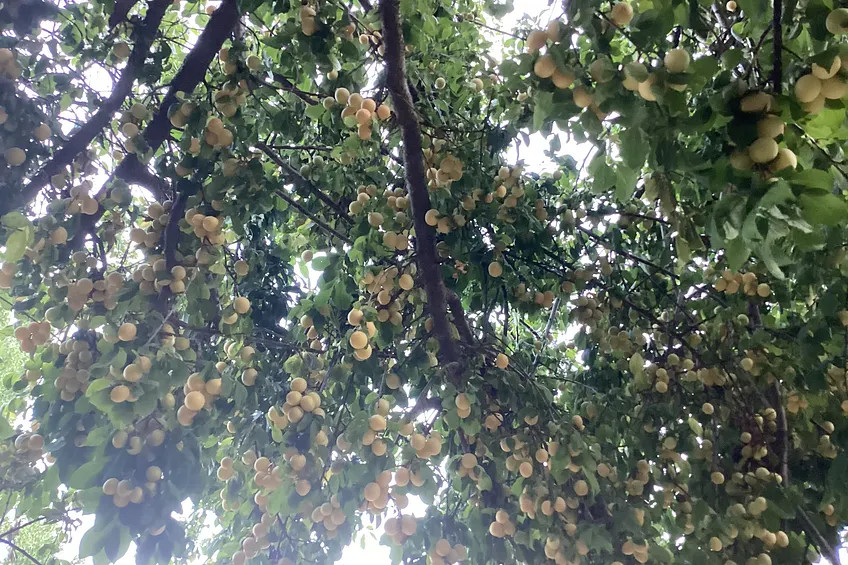
The native yellow plums along our path in the Northern California Sierras are so loaded right now that branches are breaking under the weight of their own fruit. Plums drop by the hundreds daily. We rake the path twice a day just to be able to walk on it. There are far more than anyone could eat.
That is what peak abundance looks like. Not scarcity solved. Not “enough.” More than you can hold.
The Summer Solstice was five days ago. The longest day of the year has already passed. The light is already waning ~ by seconds, by fractions too small to feel yet, but the direction has reversed. The turn happened on June 21st, and most people didn’t register it at all.
That invisibility is the point. The turn from expansion to contraction doesn’t announce itself. It happens at the exact moment when everything appears to be at maximum fullness. Branches heavy with fruit. Gardens at peak growth. Daylight stretched as far as it can reach. The landscape looks like it will keep expanding forever ~ and it’s already begun the long curve back toward dark.
Beltane marked the threshold when growth becomes self-sustaining. Litha marks something harder to recognize: the moment when abundance reaches its peak and the tide begins to turn.

The Functional Reality of Late June
By the Summer Solstice in the Northern Hemisphere, nearly everything is at or near maximum expression.
Day length has reached its longest. In the mid-latitudes, that’s roughly fifteen to sixteen hours of light. Gardens are producing faster than most households can consume. Fruiting trees and shrubs are heavy ~ stone fruits especially. Perennials are at full height, full spread, full bloom or already setting seed. Pollinators are at peak activity. Soil biology is running at maximum processing speed.
The heat hasn’t peaked yet ~ that comes in July and August, lagging behind the light by several weeks. This is one of the things the Solstice reveals: the longest day is not the hottest day. Light leads. Heat follows. The energy that drives the system has already begun to diminish before the effects of that energy reach their maximum expression.
That lag matters. It means we experience the most intense heat after the turning point has already passed. We feel summer deepening while the light is already retreating. The felt experience and the actual dynamic are out of phase ~ which is exactly why the turn is so easy to miss.
For anyone in the southern latitudes, this same week marked the Winter Solstice ~ the shortest day, the deepest dark, and the moment when the light begins its return. The same threshold, mirrored. Where the north is learning what to do with more than it can hold, the south is sitting with the least and watching for the first signs of increase. Same wheel, opposite spoke.

What Do You Do With Abundance You Can’t Consume?
This is the question the Solstice poses, and it’s one modern culture handles badly.
The plums breaking branches on our path are not a problem to solve. They are a signal to read. When a system produces more than can be consumed fresh, the functional responses are specific:
Preserve. This is when drying, fermenting, canning, and storing happen ~ not as hobby, but as the intelligent response to seasonal surplus. Every traditional food culture developed preservation techniques precisely for this window. The abundance of June and July becomes the sustenance of November and February. Preservation is the bridge between peak and scarcity.
Share. Surplus beyond what one household can preserve belongs in circulation. Neighbors, community, barter, trade. The social fabric of traditional communities was partly built on the movement of seasonal surplus ~ who has too many plums, who has too many eggs, who can trade labor for fruit.
Release. Some of it falls. Some of it feeds the soil, the insects, the birds, the decomposers. Not every fruit is meant to be harvested. The dropped plums on our path are not waste. They are the system feeding itself, building next year’s soil, attracting the pollinators and beneficial insects that keep the whole cycle running.
Rest from the intensity of producing. The tree that’s breaking under its own fruit will not fruit like this forever. It is expressing everything it has. After peak expression comes the quieter work of replenishing ~ putting energy back into roots, into wood, into the reserves that will carry it through winter and fund next year’s growth.
The modern instinct is to try to capture all of it. To feel anxious about the plums rotting on the ground. To treat surplus as wasted potential rather than systemic generosity. That anxiety, the inability to let abundance complete its own cycle is a cultural pattern worth noticing.

Fire at Midsummer: A Different Function
Like Beltane, the Summer Solstice was observed with fire across European traditions. But the fire serves a different function here.
Beltane fires were about purification and protection at a threshold of dispersal ~ sending livestock to pasture, transitioning from protection to trust. Those fires faced forward, marking a crossing into something new.
Midsummer fires are about holding vigil at the peak. Staying up through the shortest night. Keeping flame burning at the moment of maximum light ~ as if to say: we see this. We recognize this. We are present for the fullest expression before the turning begins.
Across Scandinavian, Germanic, Celtic, and Slavic traditions, Midsummer bonfires share a quality: they are celebratory but watchful. There is an awareness threaded through the celebration that this is the apex. That the year turns here. That what follows will be the long, gradual journey toward dark.
The fire at Midsummer is not about transformation or crossing. It is about witness. Marking the peak so you remember it when the days grow short and the cold returns. Building the memory of abundance that sustains you through contraction.
This is functionally different from how we typically relate to peaks. We either fail to notice them entirely (the Solstice passes unremarked) or we try to sustain them indefinitely (demanding that summer never end, that growth never plateau, that abundance never cycle back toward rest).
The Midsummer fire practice suggests a third way: recognize the peak, celebrate it fully, and let the turn happen.
The Threshold We Keep Refusing
Every spoke of the seasonal wheel so far has been about a crossing.
- Imbolc ~ hidden preparation in the dark.
- Equinox ~ calibration at the balance point.
- Beltane ~ when growth becomes self-sustaining.
Litha is different. Litha is about the moment when the direction reverses. When more becomes the beginning of less. When the thing that has been building for six months reaches its fullest expression and begins without drama, without announcement, to wane.
This is the threshold our culture refuses most completely.
We have no framework for recognizing peak and allowing the turn. Economic models demand perpetual growth. Productivity culture treats any plateau as failure. The entire structure of modern life is built on the assumption that expansion is the permanent condition and contraction is a problem to be solved.
The Solstice says otherwise. Expansion and contraction are not opposites in competition. They are phases in a single cycle. The long days make the harvest possible. The shortening days make preservation necessary. The dark of winter makes the return of light meaningful. You cannot have one without the other, and the turn between them is not loss. It is the mechanism by which the whole system sustains itself across time.
The plum tree breaking under its own fruit is not failing. It is at peak. And the peak is not a permanent address. It is a moment to recognize, to respond to with intelligence, and to release.
Marking This Threshold
If you want to acknowledge the Solstice ~ even five days late, which is fine, because the turn is still fresh and the recognition matters more than the calendar date:
Observe what’s at peak in your own landscape. Walk your yard, your garden, your neighborhood. What is at maximum expression right now? What is producing more than can be consumed?
Notice what’s already turning. The earliest spring crops ~ lettuce, radishes, peas ~ are bolting or finished. Some things have already passed their peak while others are still climbing. The turn doesn’t happen uniformly. It’s specific. Plant by plant, system by system.
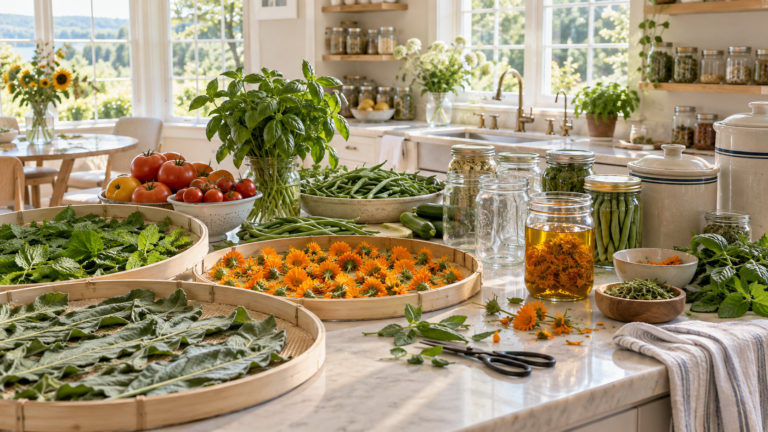
Preserve something. Dry herbs at their most potent. Make a jar of something fermented. Freeze fruit. The simplest preservation act connects you to the functional logic of this moment, converting peak abundance into future sustenance.
Let something fall. Not everything at peak requires harvesting. Some of it completes its cycle on the ground. Practicing the release, watching fruit drop without the impulse to rescue every one is its own form of seasonal literacy.
Stay up late or rise early. The Solstice is about light at its longest. Even a few days past, the difference between the earliest light and the latest dark is still extraordinary. Give that your attention for one day. Notice how much light there actually is. Build the memory of it.
The Invitation
The Solstice already happened. The turn is already underway. And that is not a loss.
It is the wheel doing what it does ~ reaching the fullest point and beginning the necessary curve toward rest, toward dark, toward the contraction that makes the next expansion possible.
The question this threshold poses is not “how do I keep this going?” It is:
What does this abundance make possible that urgency never could?
- What can you preserve now that will sustain you later?
- What can you share because you have more than you can hold?
- What can you release because not everything at peak is yours to keep?
- And where can you simply be present for the fullness ~ without trying to extend it, without mourning its passing, without missing it entirely because you were too busy to look up?
The plums are falling. The light is turning. The year pivots here, at the place of most.
What is at peak in your life or your landscape right now? What’s producing more than you can consume? How are you responding ~ preserving, sharing, releasing, or trying to hold on?
This post explores the Summer Solstice as the threshold of peak abundance and the beginning of the turn toward contraction. For those wanting the deeper exploration ~ including cross-cultural Midsummer fire traditions and their functional logic, the astronomy of thermal lag, the relationship between seasonal peak and cultural refusal of limits, and frameworks for recognizing peak in your own systems ~ the extended version is available on Substack.
If you’d like to share this piece, please link to it rather than reposting the full text. Linking helps others find the work in its original context and allows it to continue.
Thank you for reading and sharing with care.
If this work resonates with you, consider supporting it with a donation.
Your support helps keep this work going and accessible.