What got occulted at first grain ~ and what several unconnected peoples encoded there anyway
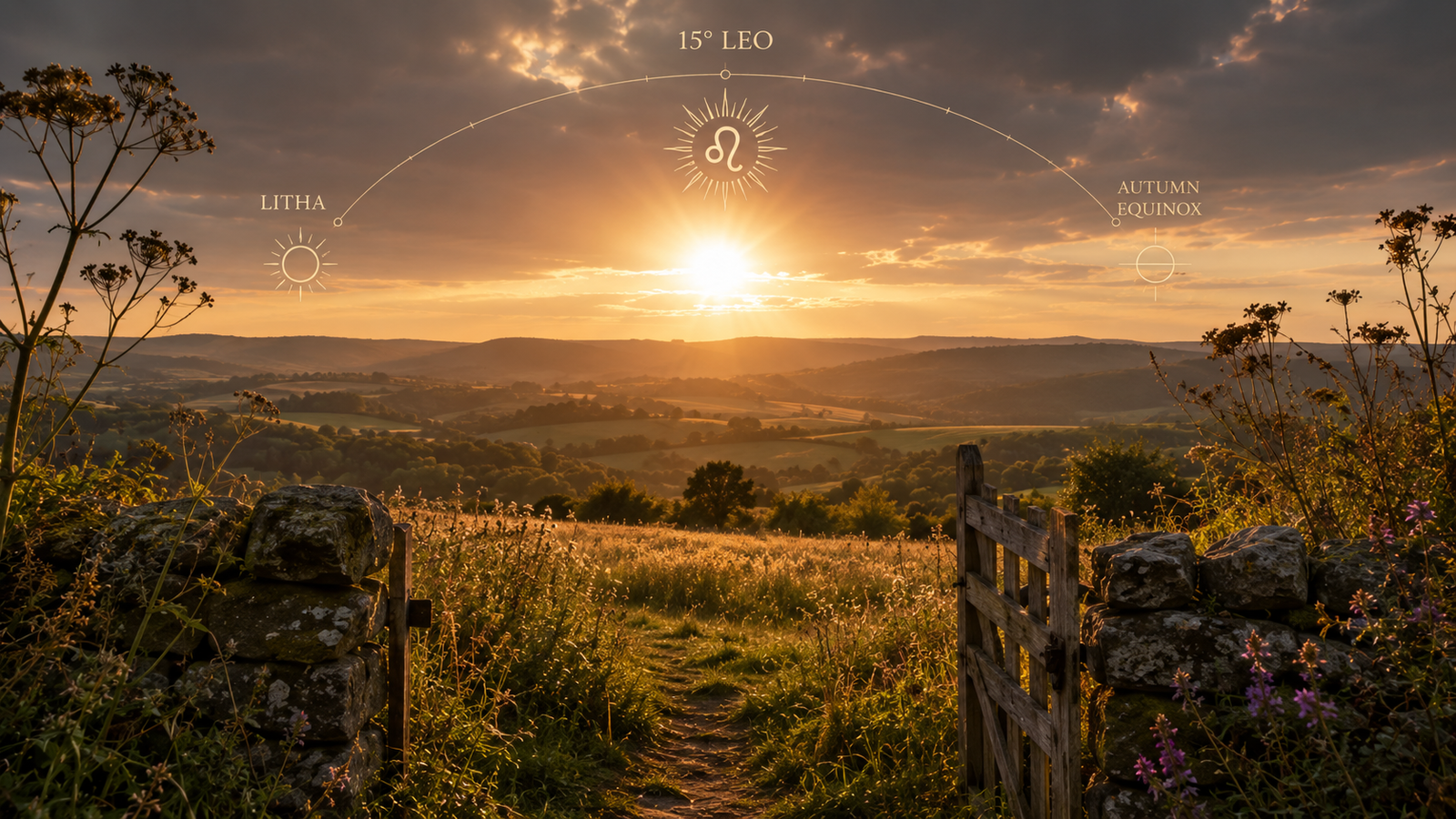
Today is August 7th. The sun sits at fifteen degrees Leo, the exact astronomical midpoint between Litha and the Autumn Equinox. Not close to it. The precise solar center of the window most of the old calendars call Lughnasadh.
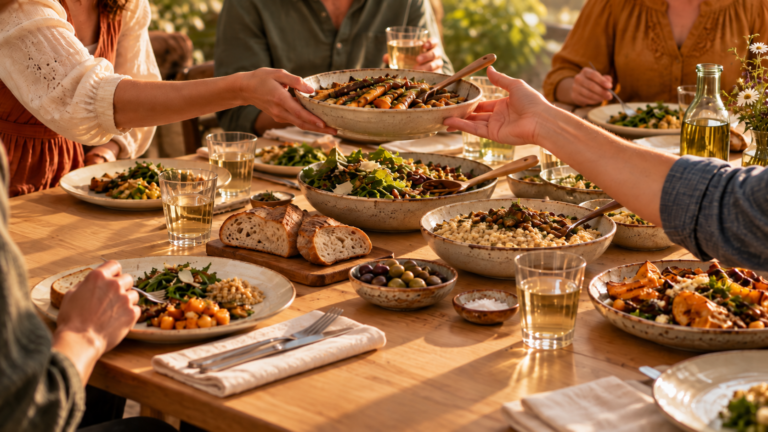
I want to open somewhere different than I usually do with a threshold piece, because this one isn’t really about me tracking a date. It’s about something stranger: independently, without contact, without shared texts, human groups on at least four continents looked at the exact same agricultural moment ~ first grain confirming itself, the labor of a whole year finally showing its face ~ and every one of them did the same thing with it. They stopped. They gathered. They named what the land had given, together, out loud, as a collective body rather than as individuals quietly noting a private harvest.
That’s the pattern underneath this whole piece, and I think it’s the actual subject. Not the date. The convergence.
The Window Itself
Most of what gets written about this threshold treats August 1st as the day, and quietly ignores the drift between the fixed calendar date and where the sun actually is. The Gregorian calendar is a human bookkeeping device. Useful. Not the sky. The sun doesn’t know what day the Pope’s calendar reformers decided August 1st should fall on in 1582. It knows its position relative to the solstice behind it and the equinox ahead, and today it’s standing in the middle of that arc.
My own tracking runs the second new moon after Litha, the same method I use for Imbolc, anchored to the light-half solstice. This year that lands August 12th. Five days from today. Not late by either measure. Standing inside a window that was open before I got here and stays open after I’ve named my piece of it.
Lughnasadh was never a single day. It was a season with a lunar marker moving inside it, both real, neither canceling the other. If you’ve ever felt behind on this one ~ like you missed the “real” date and are now doing some delayed, lesser version of somebody else’s ritual ~ let that go. You’re not late. You’re standing where the threshold actually is.

What the Bronze Remembers
In 1897, near Coligny in eastern France, someone digging turned up seventy-three fragments of a bronze plaque. Pieced back together, it revealed a lunisolar calendar from the late second century: a five-year cycle, sixty-two months, each one marked mat or anm ~ full or hollow, thirty days or twenty-nine, auspicious or its opposite. Intercalary months inserted on purpose to keep the lunar count from drifting out from under the solar year.
The old claim that Celtic peoples had no writing, no record-keeping, no capacity for abstract astronomical thought, is false. It was false when Roman writers implied it and it’s false now. This is a culture that knew the gap between the lunar month and the solar year well enough to correct for it mathematically, five years running, in bronze.
Recent reconstruction work on the tablet has located what looks like a festival marker in the month of Rivros: day thirteen, inscribed DEVOR LUG, opening an eight-day observance through the waning moon, a five-day pause while the moon sits lost in the sun’s glare, then eight more days waxing back. Lugh’s festival, timed and structured, engraved. The scholarship is still moving on the exact month, and I’d rather tell you that than hand you a tidier answer than the field itself has settled on.
Here’s what I actually want to sit with, though, more than the exact day: what happened to the rest of it. A people this capable of astronomical record-keeping did not simply lose interest in keeping records. Something happened to what they knew, somewhere in the centuries of Roman administration and then Christian scribal culture layered on top. I’ll offer one detail and let you hold it rather than resolve it for you: the plaque didn’t come out of the ground whole, or even in a handful of large pieces. Seventy-three fragments is more shattering than centuries of quiet burial tend to produce on their own. That doesn’t prove intent. But it’s the kind of detail that makes the question harder to wave off, and Rome had a documented habit of describing conquered peoples as more savage, less literate, and less sophisticated than the archaeology keeps proving them to have been. That’s a pattern, and I think it’s worth naming even where the full answer stays out of reach.
This is what I mean by occulted, in the word’s actual sense rather than its Halloween costume ~ not evil, not secret societies, just hidden from view. Knowledge that existed, that was sophisticated, that got buried under a few centuries of somebody else’s narrative about who was capable of what. The bronze survived by accident. I think about how much didn’t.
Even the name for this threshold carries a piece of that pattern, though from the Irish side of the record rather than the Gaulish. Lughnasadh comes from Old Irish násad ~ assembly, and specifically, often, funeral games, attached to Lugh. Not “Lugh’s feast,” despite how it usually gets translated. The games held for Tailtiu, his foster-mother, who died clearing the plains of Ireland for cultivation. I’ll come back to her. Her death isn’t incidental to this story. It’s the story.

Grain, Claimed Together
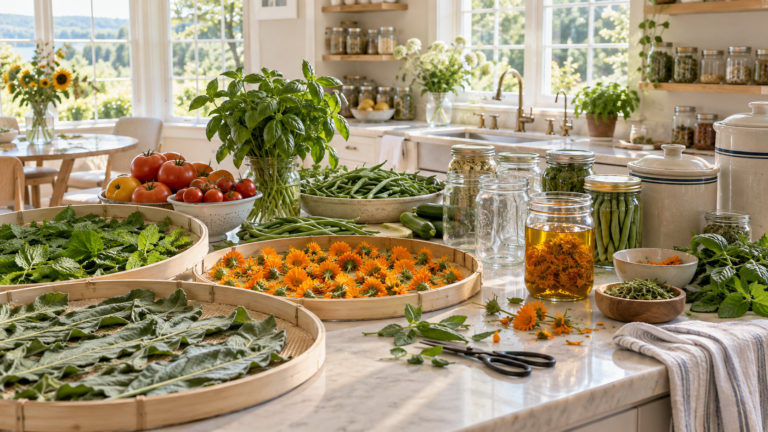
Litha gave abundance that dropped off the branch faster than anyone could eat it ~ stone fruit splitting under its own weight, overflow that asked nothing of you but to receive it. Lughnasadh is a different register. This is grain standing in the field, ready for the scythe, and it doesn’t fall into your hands. Somebody has to go get it. And critically, nobody got it alone.
I want to be precise about something that gets flattened too often into a single story. Small-plot grain cultivation coexisted with forest and hedgerow for millennia before the damage most of us associate with agriculture ever began. People were growing grain in clearings, in rotation, alongside standing woodland, long before anyone plowed a continuous monoculture field from horizon to horizon. The topsoil loss, the disrupted water cycle, the biodiversity collapse ~ that’s a later development, forest clearing at scale and continuous plow farming displacing the older, more integrated pattern. Marking first grain isn’t the same act as what agriculture became centuries later. I want this said directly so the piece doesn’t read as an endorsement of what came after: the threshold itself is older and more modest than its later consequences.
That first grain became bread almost immediately, and the English name for this threshold still carries the memory. Lammas, from Old English hlāf-mæsse, loaf-mass ~ the first bread, baked from new grain, spoken over before it was eaten, and eaten in company. The word harvest carries its own quieter shift: Old English hærfest, cognate with German Herbst, which still means autumn there. Originally the word named the whole season, not the act of gathering grain out of it. Somewhere along the way its meaning narrowed from an entire stretch of shared time down to a single solitary verb. Language does this. It takes something communal and compresses it into a task one person does alone.
“Spoken over” is doing more work in that sentence than it looks like. The word we’d reach for now is bless, and I want to slow down on it, because its root runs deeper and stranger than the sense we inherited. Bless comes from Old English bletsian, and underneath that sits blod. Blood. Before Christianity absorbed the word and gave it a sanitized spiritual meaning, bletsian described consecration by blood, on altars, on sacred objects, at exactly this kind of seasonal threshold. What actually happened is narrower and stranger than most people realize: the older, local version of blood consecration got relabeled as pagan and primitive, while the tradition that absorbed the word kept its own blood language and called that sacred instead. Same underlying act. Different label, depending entirely on who was doing the naming and who had the power to make the label stick.
So instead of blessing the harvest, I want to offer the older phrase, stripped of what got layered onto it later: named the harvest, gave it thanks. That’s what was actually happening at this threshold. You look at what grew. You say what it is, out loud, in front of other people. You say thank you for it, together. No priest required. No blood on the altar necessary. Just the plain, collective act of acknowledgment ~ which, I’d argue, is the actual root of every “blessing” that came after, stripped back down to what it was before institutions got involved in administering it.

Tailtiu’s Games
Back to her. Lugh established these games in honor of Tailtiu, his foster-mother, who died of exhaustion clearing the plains of Ireland for cultivation. Read that again. Her death is explicitly agricultural. She isn’t a goddess of grain in the abstract. She’s the labor itself, spent to make the land arable, and the games held in her name aren’t decorative myth stitched onto a harvest festival after the fact. They’re the social connection this threshold actually calls for.
Think about the timing. This is the one moment in the agricultural year when scattered communities had both the labor freed up and the produce to show for it. You can’t gather like this during planting season ~ everyone’s in the fields. You can’t gather in deep winter ~ everyone’s scraping by. But right here, at first grain, with the fields proving themselves and people having a few days before the real work of storage and preservation sets in, this is when you test skill against skill, when scattered households become, briefly, one body in one place. The fields prove themselves at this threshold. So do the people, in front of each other, on purpose, at the exact moment they have something to bring.

The Thread That Never Actually Broke
Gŵyl Awst isn’t a separate tradition sitting alongside Lughnasadh for comparison. It’s the same threshold wearing a different language. Welsh for “the feast of August,” it’s the direct linguistic descendant of this exact marker, later folded into Christian practice without the underlying line ever actually severing. The thread didn’t break. It got renamed by whoever held the naming power at the time.
Further afield, and I want to give this real weight rather than a passing nod: the Haudenosaunee Green Corn Ceremony is one of the clearest structural parallels you’ll find to “first fruits, first claim, communal gathering timed precisely to a crop’s readiness.” I want to be careful here, because this isn’t the same tradition in different clothes. Distinct peoples. Distinct cosmology. A wholly distinct relationship to land and to corn specifically, developed on its own terms over thousands of years with no contact whatsoever with anything happening in Iron Age Europe. What’s parallel is the underlying logic: watch the crop, mark the moment it confirms itself, gather the people at exactly that point, as one body, not as scattered individuals privately noting their own yield.
In Athens, the Kronia fell in late July or early August, in the month of Hekatombaion, honoring Cronus at the close of the grain harvest ~ a single day when the ordinary hierarchy inverted itself, when the enslaved feasted alongside the free, evoking the old Golden Age of a world that provided for everyone without demanding toil in return. In Egypt, Wepet Renpet, the Opening of the Year, arrived a little earlier, tied to the heliacal rising of Sirius and the start of the Nile’s flood, the event that made the whole agricultural cycle possible in the first place. Not identical timing. Not identical crop. The same underlying pattern: watch the sky, watch the land respond to it, and when the threshold arrives, mark it together.
I don’t think this is a Celtic peculiarity, or a European one, or an accident repeating itself by coincidence four separate times. I think it’s what happens when human beings give real attention to land, labor, and sky, wherever on earth they happen to be standing, and I think the fact that it happened independently, without shared text or contact, is itself a kind of evidence. Evidence of what, I’ll let you sit with. I have my own read on it, and it has more to do with something encoded in how humans actually organize around a living world than with coincidence. But I’d rather point at the pattern and let you draw your own line through it than hand you my conclusion dressed up as fact.

What Gets Lost When the Gathering Stops
Here’s the part that sits heaviest with me. Lughnasadh fairs, historically, were hiring fairs too ~ places where seasonal labor got contracted, trade happened, temporary workforces converged because the harvest demanded more hands than any one household had on its own. The threshold wasn’t only spiritual. It was logistical. It was the mechanism by which a whole region’s labor and produce and relationships got renewed at once, in person, in the same place, at the same time.
I think about how much of that has quietly gone missing. Most of us now harvest, metaphorically, entirely alone ~ close out a project, finish a season of effort, and there’s no gathering built into the culture where that gets named out loud in front of other people who knew what it cost. We’ve kept the labor and lost the convergence. The fields still fill, in whatever form our version of a field takes, but the games got cancelled somewhere along the way, and nobody quite noticed the loss because there was no ceremony marking its absence either.
That’s the actual damage, I think, underneath everything else this piece has traced. Not just that we stopped growing grain in small plots alongside forest. Not just that the old calendar got replaced by a newer one. It’s that the collective half of “named the harvest, gave it thanks” got stripped out somewhere along the way, and what’s left is a private, silent accounting that nobody else ever hears.

The Window Is Open Now
The question underneath this threshold was never only “what am I harvesting,” taken literally, though that matters too. It’s what has this year’s labor actually produced, and are you willing to say it out loud, in front of people who’ll actually hear it. Litha asked you to receive more abundance than you could hold. Lughnasadh asks something different: to choose what you’re keeping, what you’re processing, what you’re carrying forward into the leaner months ahead, and to do it where it can be witnessed rather than filed away privately.
Today through August 12th, there’s no single correct day for this. The threshold has been open the way it’s been open for two thousand years of tracked lunar months and reconstructed festival markers and whichever exact day the bronze actually points to, still being argued over by people trying to read what got fragmented. Not blessed, in the sense the word settled into. Named. Given thanks. Together, if you can find the people to do it with.
This is where the deeper thread of this lives, if you want to converse on it ~ the THSoC Skool, and the conversations happening there about what else has been occulted and is worth reclaiming.
If you’d like to share this piece, please link to it rather than reposting the full text. Linking helps others find the work in its original context and allows it to continue.
Thank you for reading and sharing with care.

If you’re feeling the call toward interdependence, toward conscious paradigm shift, toward walking with others who are actually doing this work…
Join our community to explore the cosmological foundation of conscious living, engage with others awakening to their role in Unity Consciousness, and discover the deeper practices that activate this remembrance.