
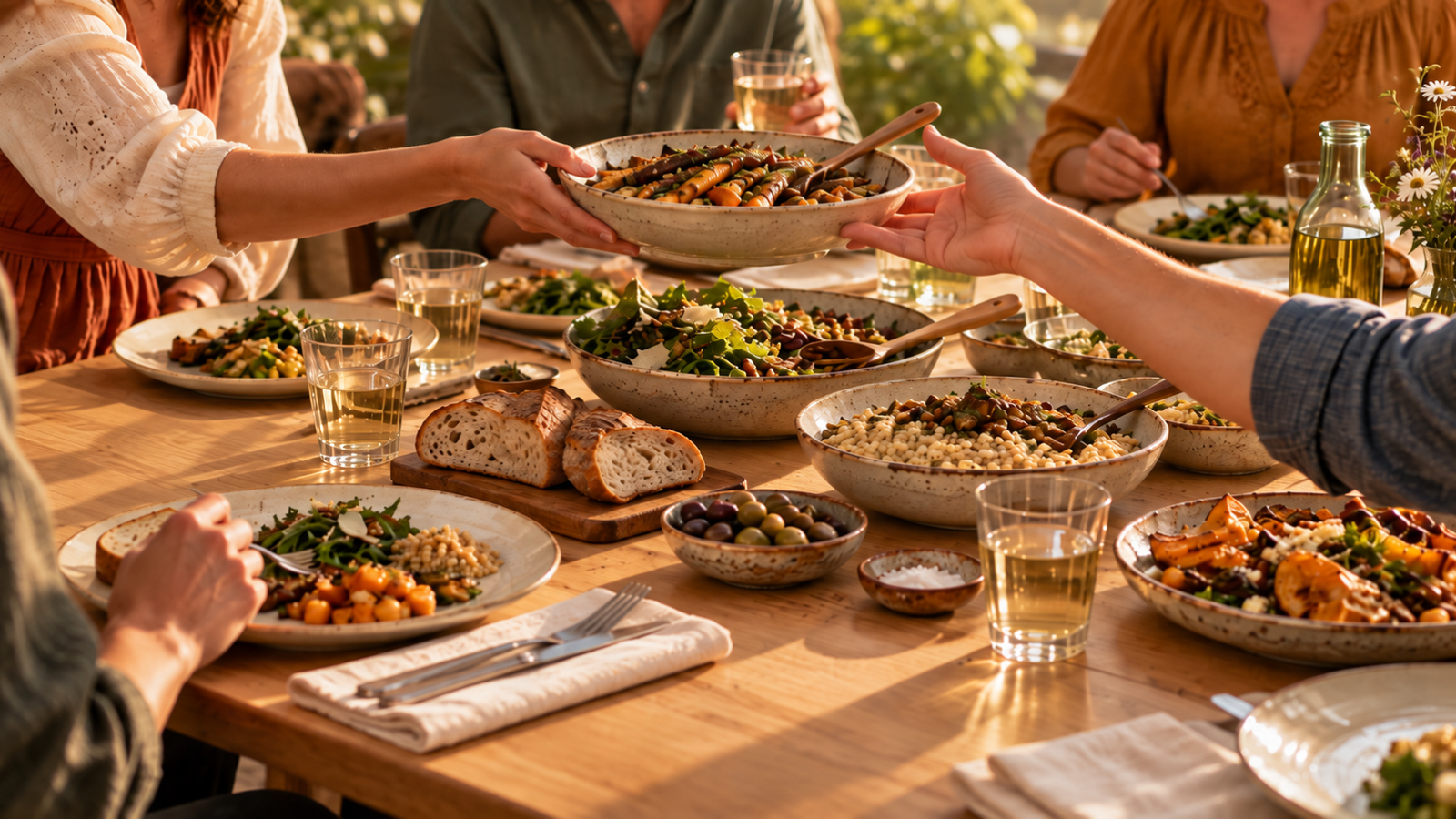

What a shared meal asks of the one who sets it down
A dear friend of mine, now ninety, does not eat from potlucks. He told me why the way a man reports the weather. Over a long life he had stood in a great many kitchens, watched cats walk the counter where the casserole was assembled, found dog hair drifting through a refrigerator of uncovered bowls. He made his decision decades ago and never revisited it. I laughed a little at the time. I have not forgotten a word of it since.
Potluck etiquette, as most of us inherited it, asks a great deal of the guest and very little of the cook.
Thirty years of rural living, mostly in communities where the shared meal holds the social cloth together, have given me my own collection of kitchens. Dishes carried to the table from homes without hot running water, by choice, where rats and cats shared the counters and the person handling the food had come in from the animals with no warm water to wash with. Vegetable beds framed in creosote-soaked railroad ties, with raw manure spread across the surface and no composting in between. Raw dairy where sanitizing the jars and replacing the rusted lids fell to me, the buyer. None of it belongs to one place. It is a pattern, and it ends the same way every time: a dish set down among the others, called wholesome, with nothing said about where it came from.
People may live as they choose. The trouble starts at the threshold, where food leaves one kitchen and enters another person’s body. At that point it has become a shared matter.
What the word community already says
Community comes from Latin communis, held in common. Many of us learned it as com plus unity, together and one, and the sound of the word invites that reading. The roots run differently: unity descends from unus, one, and communis does not. The usual account builds communis from com, together, and munus, which meant a duty, a service owed, a gift given. Hold that second half up to the light for a moment. The oldest layer of the word carries an obligation inside it. A community is a group of people who owe each other something, and the shared table is where that debt gets paid or quietly skipped.
Seen from there, the behaviors I keep running into share a single shape, and the shape is extraction. The dish with no ingredient card takes the guest’s choice and keeps it. The plain lie, dairy-free when it was not, garden-grown when it came from the discount bin, takes the guest’s body as the price of the cook’s pride.
The lie I have met most often, and been ridiculed for asking about most often, concerns how the food was grown. Ask whether the vegetables were organically grown and the answer comes back yes, warmly and with confidence, until you learn they came from the conventional discount bin. Ask in a way that suggests you would like to know, and the word organic turns into a mark against you, proof that you are fussy and make things hard for everyone. A plain statement would settle it: grown organically, or grown conventionally. Either one is a perfectly good thing to say aloud. The only version that damages a community is the one where the truth gets managed.
The household that eats organic at home and brings the cheapest sprayed product to the community table has settled the question of who counts: clean food for us, anything for you. And the small-town habit of treating a declined dish as a declined person takes one more thing, the guest’s standing, because the one who asks is made to pay in invitations and reputation.
The Greeks gave us the word for this figure. A parasitos was, in its earliest Athenian use, a respectable attendant who shared the sacred meals at public festivals. Over the centuries the meaning slid toward the one who eats beside you and contributes nothing, and the biologists inherited that sense whole. I will defend living soil as hard as anyone, and I have spent thirty years building it on purpose. But raw manure on a vegetable bed and a healthy compost pile are separated by months of heat and time, and skipping that process skips the entire reason the practice was ever safe. Whatever gets welcomed to the table on principle, the old definition still holds: the one who takes.

The old shape of hospitality: xenia and the host’s duty
For most of human history the weight of the table rested on the host. Xenia, guest-friendship, was among the gravest covenants the Greeks recognized. The host owed the stranger a meal, a bed, and above all safety beneath the roof, before even asking a name. Hospitality itself comes from Latin hospes, a single word that meant host and guest at once, as though the two ends of the relationship could not be thought of apart. Even potluck, when it first appears in English in the 1590s, named whatever was simmering in the pot when an unexpected visitor arrived, offered with some humility, the host’s reputation riding on what came out.
Somewhere along the way the debt changed hands. The modern guest owes the host acceptance before asking a single question, and the guest who asks anyway is the one made to pay.
The circle has no head
There is a piece of geometry in all this that I keep returning to. A round table has no head. Every seat sits the same distance from the center, and whatever is placed at the center is equally available to every person around it. The pattern holds a promise that goes beyond furniture: what lands in the middle belongs to everyone, so everyone is owed the truth about it. A table where one person’s convenience outranks the others’ knowledge has quietly stopped being a circle. It has become a line with someone at the front.
Restoring the circle takes very little. Say what is in the food. Say how it was grown and in what, and how the kitchen was kept. A person who chooses to live without hot water or to grow in surface-spread manure is free to do so, and free to offer the result, provided the guest can choose with open eyes. Yes, I’ll have some. No, thank you. Either answer lands without penalty, and in a community with its courtesies intact, it always did.
Integrity comes from Latin integer, whole, untouched. A dish offered with its full story is whole in the old sense. A dish offered with its story withheld has had something removed, and what was removed is the guest’s choice.
My friend at ninety passes on the potluck with no apology at all, and I have thought a lot about how rare that ease has become. When did having standards about what enters our own bodies turn into the problem at the table? I have no tidy answer. I would like to hear yours ~ and what the circle looks like where you live.
The comments on this blog fill with spam faster than I can clear them, so the conversation has moved to where it can actually happen. It lives in the The Heart Song of Creation Skool, where we can talk in threads and meet on video calls. Come say what the table looks like where you live:
✦ Where the conversation lives
The comments here belong mostly to spam, so the real conversation happens in the THSoC Skool. We talk in threads, share what we are noticing, and meet on live video calls. Come join the circle, and bring the question this piece raised for you.