
On the duality we carry, and the world we never actually left
The conversation started, as many of ours do, with something specific ~ tipis and yurts, those structures that surface regularly in the fantasy of living close to the land. The dream of stepping outside modern comfort into something more aligned, more honest, more nature-forward.
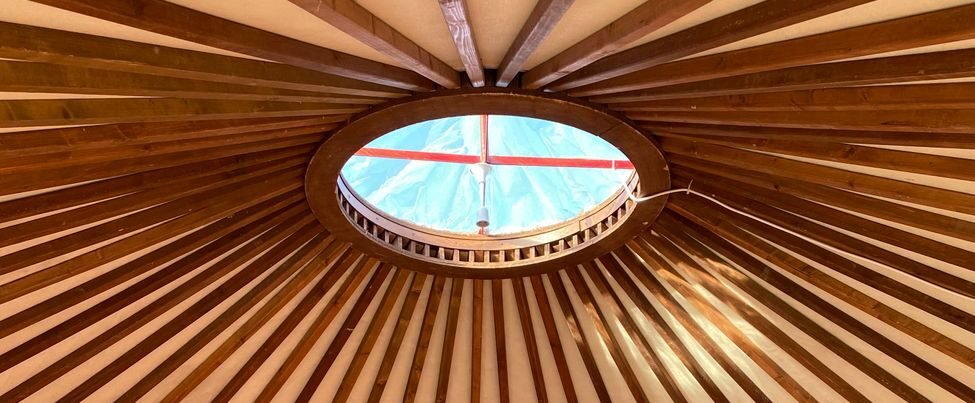
I have lived in both. The yurt is a modernized version on a platform with a kitchenette ~ glamping, if we’re being precise about it. The tipi was closer to the real thing. And I want to say something plainly about that experience: these structures are not romantic to live in. They are genuinely difficult. The day-to-day reality demands more of you, not less ~ more time managing the space, more negotiation with weather and light and critters, more attention just to keep things functional. The romance is something people bring from the outside. It is not something the structures themselves generate.
That matters, because the romance points toward something worth examining.
✦
The nomadic peoples who developed these structures, the tribes of this continent, the pastoral peoples who crossed the northern deserts of Asia, were not living in them because they represented some ideal relationship with the land. Many were nomadic because they had been displaced from their original place. Their ancestors were not always nomadic. The tipi and the yurt are adaptations to forced movement as much as they are expressions of ecological intelligence, and collapsing that history into a lifestyle aesthetic loses something essential about what those peoples were actually navigating.
Then there is the land management question, which is almost universally misread in the modern romanticization of indigenous life. The land those peoples inhabited was not unmanaged. It was not pristine wilderness in the sense we tend to imagine ~ untouched, unshapen, allowed to go fully wild. They knew the land. They worked with it, observed it, directed it. The assumption that living in harmony with the land means leaving it entirely alone is a projection, not a perception ~ and it is worth sitting with the distinction between those two things.
✦
Shantparv raised something in our conversation that I keep returning to. He observed that most parks, even carefully designed ones, even those built with real intention ~ are not put together in guilds of plants that are supportive of each other. The kind of mutual support that brings individual plants to health and fullness, that creates resilience across an entire system rather than in isolated specimens. That observation, he said, is the foundation of what we now call permaculture ~ though the methods themselves are far older than the name. Permaculture is modern coinage for something ancient: observing nature closely enough to comprehend the grace and health and power of it, and then working with that comprehension rather than against it.
Those land managers knew plant guilds. They knew that close observation is not a passive act ~ it is an active form of intelligence, the prerequisite to everything that follows from it.
✦
Which brings us to where the conversation moved, and the thread that has stayed with me most.
We are nature. That is not a philosophical position so much as a plain description of what is true. I am nature. You are nature. The raccoon on the fence line is nature. The manicured yard is nature. The city park is nature. The unmanaged hillside is nature. The balcony in New York City with its container herbs is nature. Even the concrete reaching skyward in a place like Hong Kong is, in a sense, nature ~ because humans built it with the natural materials of clay and sand and stone, because that is what concrete is, no matter how ugly it may be in in it’s grayness.
The duality we have constructed ~ nature as somewhere else, somewhere you go, somewhere requiring a special trip or a particular aesthetic of wildness ~ is a projection layered over a reality that has not actually changed. You have always been in it. The question is only what kind of relationship you are building with the nature you are already inhabiting. A house with sliding glass doors opened to the morning air is a relationship with nature. An apartment with a south-facing window ledge and something green on it is a relationship with nature. The relationship does not require the tipi. It requires attention.
✦
He said something toward the end of our conversation that I have been turning over since.
He was speaking about what true perception actually requires ~ what it takes to see the land you live on, the system you are already part of, clearly. Full reception leads to true perception, he said. That we shy from full reception because we want to project what we have been taught as the way to go, the way to be. That receiving what is ~ allowing it in as it actually is, without the overlay of what we expect or prefer or have been handed as the correct interpretation, is one of the most powerful capacities available to us, precisely because it is the entry point for seeing anything at all.
That lands differently when you hold it against the romanticization of tipis. Or against the idea that nature is somewhere you have to go to find. Or against the assumption that the indigenous relationship with land was characterized by beautiful passivity rather than active, sophisticated observation. All of those are projections. They sit between us and the actual world we are living in, and they make that world harder to see and harder to work with.
What would it look like to simply receive what is here? The yard as it is, with its particular plants and its particular light and its particular history of management or neglect. The neighborhood with its street trees and the weeds coming through the sidewalk cracks. The park that was designed without plant guilds in mind but still has something alive and reaching in it.
That is where the relationship begins. Not in a yurt. Not in a tipi. Here, in what is already present ~ received fully enough to actually see it.
✦ The conversation continues in the The Heart Song of Creation Skool ✦

A space for the kind of thinking that does not fit neatly into a comment box, with people paying close attention to the world they are already in.
If something here is sitting with you, bring it there.
Join the The Heart Song of Creation Skool community →
PRIVATE
&
Still FREE