On being passed over, the work that goes on underground, and the old kinship between humus and humility
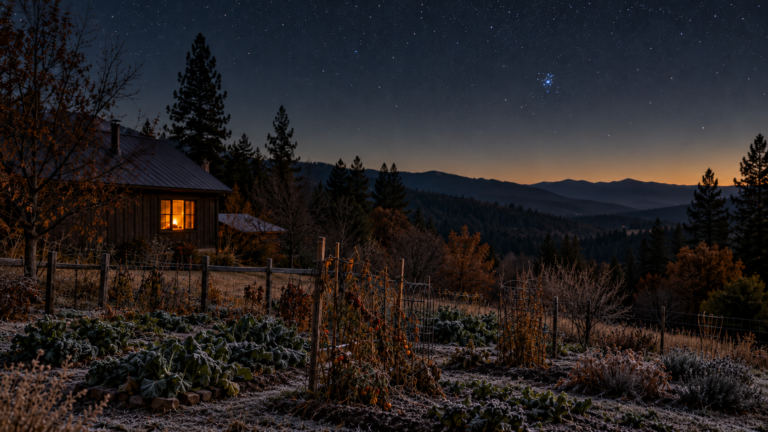
Earlier this month I drove down to the Grange with a talk in my bag and a stack of handouts. It was dark by the time I parked, with the oaks along the road gone to silhouette, and I had spent the week shaping what I wanted to tell my neighbors about building garden beds in the dark season: why November is when that work begins, what is moving in the clay right now, what to lay down and then leave alone. The meeting ran its course through reports and old business, and the evening wound to its close without my name being called. It wasn’t the first time. I gathered my things, set the handouts on the table by the door where anyone could take one or leave it, and walked back out into the cold.
Somewhere along that dark road, the shape of the evening came clear to me, because the whole talk had been about work nobody sees.
What the clay is doing
Under yards and orchards and forgotten corners all through these foothills, living things are working through what the summer left behind. Fungi are threading slowly into fallen wood. Worms are drawing leaves down into the clay a few at a time, and bacteria are keeping their patient accounts on everything that died back in October. None of it shows from the path. What comes of it shows in April, or fails to, depending on what was laid down in November and December.
In the Samhain piece I wrote about the old Gaelic year turning at the threshold of its dark half. The soil keeps that same calendar, and starts its year where no one can see it. This is occult work in the first sense of the word, the one I followed in What Is Actually Hidden: covered over, out of view, and entirely real.

Humus and humility
There is a family of words I have been sitting with since that evening. Latin humus means earth, the ground underfoot, and the gardener’s word for the dark, settled matter that rich soil is built from comes straight from it. From the same root Latin made humilis, low, close to the ground, and that is where humble comes from. Most etymologists trace homo and human back to the same ancient word for earth as well, so that a human was first of all an earthling, a creature of the ground, set apart from whatever was imagined to live in the sky.
In its oldest sense, then, humility was less a virtue than a position: low, near the soil, where the work is. For one evening at the Grange I was put there, and I’ve decided to take it as information about where the work happens rather than a verdict on its worth.
Most of what keeps a place alive goes on at that height. Somebody straightens the chairs after the meeting. Somebody takes out the trash. Somebody keeps the records, waters the hall’s planters, fixes the gate latch, leaves a stack of paper by the door. None of it gets a slot on the agenda, and the place would come apart within a season without it.
What looks used up
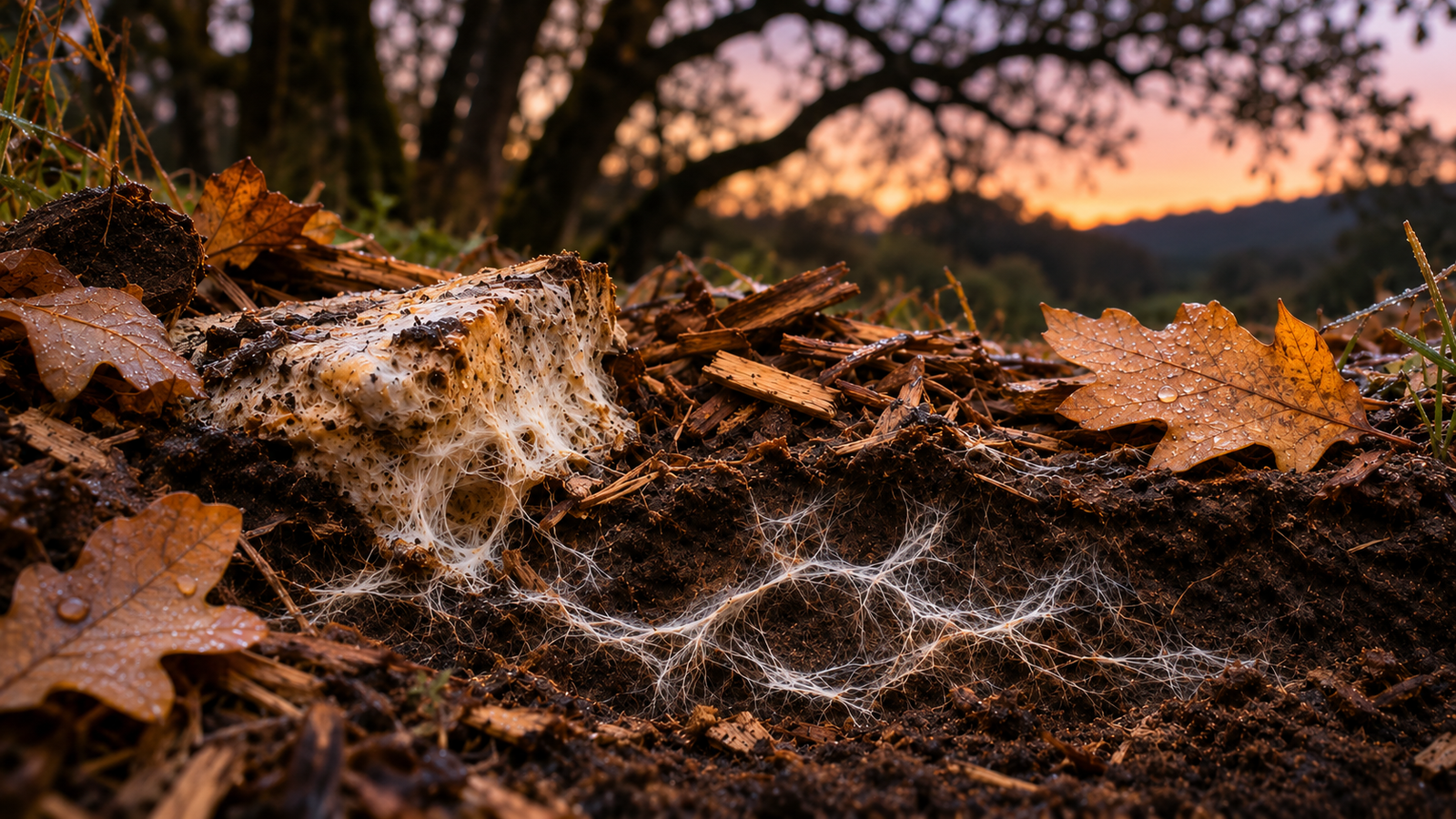
I’ve been setting spent mushroom blocks into the wood-chip layer of new beds for years. Local growers sell them for about a dollar once they’ve finished harvesting, and they look exhausted: pale, crumbling, their fruiting done. The mycelium inside is still alive, though. Given damp wood and a winter, it runs out into the bed on its own, and by spring the chips are laced with white.
I think about what our culture calls spent. Across much of the human record, the old were where knowledge was kept: they remembered which spring had failed in a drought year, which plant was ready when, and what the grandmothers did the last time things went hard. A culture organized around visible output tends to retire its elders from view at exactly the age when what they carry is most complete. Something similar happens to anyone whose fruiting season has passed for a while, through illness or grief or simply a long tending of others. They look finished from the outside, and they very often aren’t.
The threads, held loosely
Fungal threads bind loose particles of soil into crumbs, and those crumbs hold the pockets of air and water that roots and soil life depend on. The structure of good ground is woven from countless fine threads, each one too thin to notice, and the bed holds together because of all of them at once.
That’s the picture I’d offer for a community. A living community is held together by a great many small threads of attention, most of them running where nobody is looking. You can’t see them from the street, any more than you can see the hyphae in a bed of chips. You find out they’re there when you push your hand in.

The bed that looked right
My first bed in Nevada County looked like everything a gardener hopes to find: dark, loose, and described to me as good amended soil. Seeds never came up in it. The one-gallon starts, thriving in their pots, went into that ground and shrank. I’ve written elsewhere about the chemistry that likely caused it, the herbicide residues that ride in on straw and manure and compost. What stays with me is how right it looked. The amendment carried the harm, and the harm made the bed look richer.
From a systems perspective, the look of richness and the life of it are two separate measures, and from the path there is no telling them apart. Communities can show the same split. A space can look full, with a busy feed and big numbers and plenty of surface activity, while very little takes root. Another can look nearly bare, a handful of people and a quiet room, while something underneath is slowly knitting the ground together. The only test I trust for either is the one I use on a winter bed: go close, push a hand in, and notice what comes up.
By the door
I don’t know how many of those handouts went home with someone. A few are probably on kitchen counters, a few in the recycling, and maybe one is folded into a seed catalog to be found again in March. That’s how leaves go down too, a few at a time, and most of them disappear into the work without anyone keeping count.
What are you laying down this winter that no one will see? And who in your own life is doing the quiet work that holds the ground together? I’d like to hear about them. Come tell us in the THSoC community.
This piece grew from an essay on my Substack, “The Ground Nobody Sees,” which goes further into the soil chemistry and the history of the word landscape*:
✦ The Heart Song of Creation on Skool is a smal space, kept open by the people who want this kind of conversation to exist. Live calls, the music library and the slow work of the community live there. Come sit with us: The Heart Song of Creation SKOOL LINK