On Seed Sovereignty, Enclosure, and What Was Quietly Taken
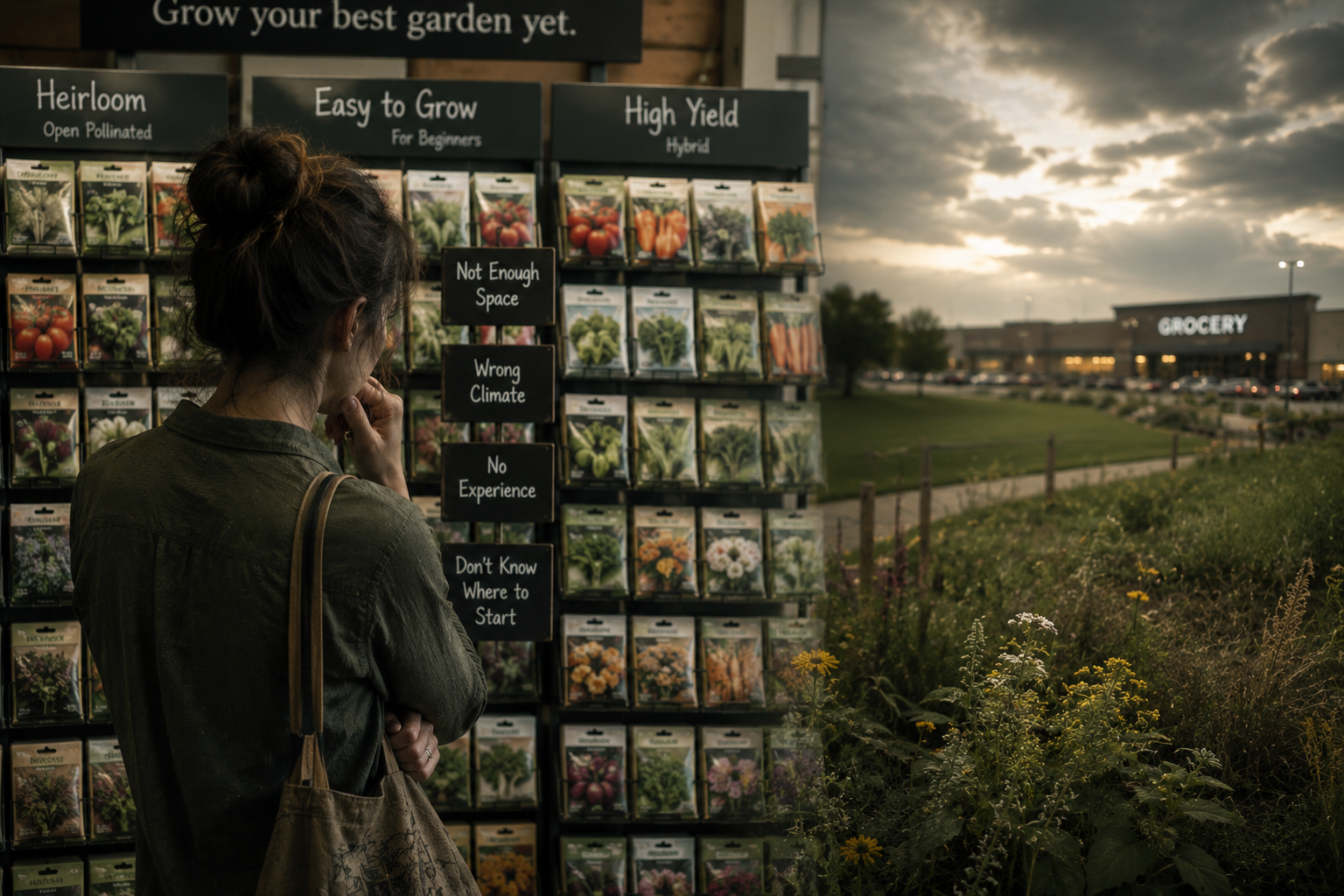
The seed rack at the hardware store looks abundant.
Dozens of varieties. Bright packets. Photographs of improbable tomatoes and oversized zucchini. Heirloom labels mixed in with hybrid designations. It feels like choice, and for most people, it reads as choice. You pick what looks good. You go home and plant it.
But look closer at what you actually took home.
The Distinction That Changes Everything
Open-pollinated seeds reproduce true to type. Plant them, harvest their seed, plant that seed the following season, and what grows will be recognizably the same plant ~ carrying the same traits, the same flavor profile, the same adaptations to your specific conditions.
Hybrid seeds do not.
F1 hybrids ~ the dominant commercial variety in most seed racks, are produced by crossing two parent lines to produce a first generation with reliable uniformity and vigor. That uniformity is real. That vigor is real. But save seed from an F1 hybrid and plant it, and what emerges in the second generation is genetically chaotic. Some plants revert toward one parent line. Some toward the other. Most fall somewhere unstable in between. The predictability that made the hybrid useful is gone.
Which means: you cannot save hybrid seed and get what you had.
You are back at the catalog. Every season. By design.
This is not an accident of plant genetics. It is a business model.

What Enclosure Actually Looks Like
In the 1980s, utility patents on plant genetics became legally enforceable in the United States. What had been open ~ shared laterally between farmers, adapted regionally over generations, selected for local conditions by the people growing in those conditions ~ became intellectual property.
A product you license. Not own.
Genetic modification extended this logic further. Genes spliced in from unrelated species to confer herbicide tolerance or pest resistance. Patented. Proprietary. Often engineered to function only alongside the chemical products sold by the same corporation that produced the seed.
Save those seeds and replant them? That’s a licensing violation. There are farmers who have been sued for it.
The scale of this enclosure in industrial agriculture is staggering. But the home garden version is quieter, and therefore harder to see.
Most gardeners buy new seed every year without questioning it. The catalog arrives. You order. It’s convenient. The relationship between a grower and their genetics, the relationship that produced the diversity of food plants we inherited from ten thousand years of agricultural selection, quietly atrophies.
What a Landrace Actually Is
Before hybrid agriculture, before utility patents, before the seed industry as we know it, farmers selected.
Every season, you saved seed from the best performers. The tomato that ripened earliest in your short-season climate. The bean that resisted the particular fungal pressure in your wet valley. The squash that stored longest through your winters. You planted those seeds. Selected again. Planted again.
Over generations, something specific emerged ~ a variety so adapted to your place, your conditions, your selection pressure that it carried the intelligence of that place in its genetics. It performed reliably not because it was engineered for uniformity, but because it had been shaped by the actual conditions it grew in.
This is a landrace.
A landrace cannot be separated from its context without losing what makes it valuable. It belongs to the land and the people who selected it. It is not transferable in the way a patented seed is transferable. It cannot be scaled, standardized, sold globally. It is, in the deepest sense, not a product.
Which is precisely why it had no place in an agricultural economy built around products.

What Seed Saving Restores
When you save seed from an open-pollinated variety, you begin, even in the first season, to participate in this process.
The plant that performed best in your specific microclimate. The one that germinated earliest, resisted your local pest pressure, produced fruit with the flavor that worked for your kitchen. That plant’s seed carries information your catalog seed does not have: information about your place.
After five seasons of selection, you are growing something that genuinely belongs to your garden. After ten, you have something irreplaceable ~ a variety adapted to conditions that no seed company has mapped and no patent can capture.
This is not sentimentality about the old ways.
It is the restoration of a relationship between grower and genetics that industrial agriculture systematically severed. And with it ~ the restoration of a particular kind of competence. The knowing that comes from participating in a living system rather than purchasing its outputs.
Your body registers the difference. So does your soil.
The Pattern Beneath the Seed Rack
From a systems perspective, the seed enclosure and the soil sterilization and the chemical contamination are not separate problems. They are expressions of the same underlying logic: extract what can be commodified, sever what cannot, and sell the outputs to people who no longer know how to produce them.
The seed rack looks like abundance. What it represents is the final step in a very long enclosure.
The good news ~ and there is genuine good news here ~ is that open-pollinated genetics are still accessible. Heirloom seed libraries exist. Seed swaps happen. The varieties that carry thirty, a hundred, three hundred years of selection pressure in their genetics are still findable.
And every season you grow them is a season you are rebuilding what was taken.
The full systemic analysis ~ how the soil betrayal, the seed enclosure, the glyphosate contamination, and the nervous system cost of losing food sovereignty all connect ~ is in the current Substack essay series. Parts 1&2 are live now.
NaturWise Living ~ naturwiseliving.substack.com
If you’d like to share this piece, please link to it rather than reposting the full text. Linking helps others find the work in its original context and allows it to continue.
Thank you for reading and sharing with care.

Continue the Conversation
NaturWise Living Skool is a free community for those building a natural lifestyle ~ from seed to table ~ through organic living, permaculture, and herbal health, without overwhelm or the requirement to homestead.
It’s a space for learning slowly, asking questions, and reconnecting with seasonal and earth-based ways of living.
→ Join NaturWise Living Skool
If this work resonates with you, consider supporting it with a donation.
Your support helps keep this work going and accessible.