
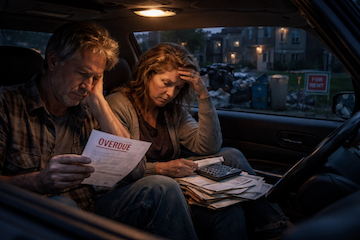

There’s a family in my community with seven professional certifications between them. Skilled trades. Healing modalities. Years of training. Genuine expertise.
They lived without access to a refrigerator for over a year. Not because one doesn’t exist where they were staying, it did. Because the family member providing grudging shelter decided they didn’t deserve to use it.
This isn’t a story about personal failure. This is a pattern I’ve witnessed replicate with mathematical precision. And, it’s a systems indicator screaming that something has fundamentally broken in the connection between work and survival.

The Mathematics Nobody Wants to Face
When minimum wage was instituted in 1938 at $0.25/hour, it was designed to provide a basic standard of living. If we calculate what that same standard of living requires today, minimum wage should be approximately $115 per hour.
Not $7.25. Not $15. Not even $25. $115/hour for unskilled labor to maintain 1938 standards.
From a systems perspective, this number makes people uncomfortable because it reveals how profound the degradation actually is. We haven’t just fallen behind incrementally. We’ve systematically dismantled the entire premise that work should provide for basic survival.
Now consider: if unskilled work should pay $115/hour, what should skilled trades command? What should professional certifications be worth?
The family I’m describing should be earning $460-690/hour combined for their expertise. Instead, they’re offered $20~75/hour when work comes. And told it’s generous.
They’re earning 4-10% of what their expertise should command.

The Pattern: Promises That Become Traps
This family was struggling in one region. Scarce work. Insulting wages. Thanks to slander. Then came an offer ~ opportunity across the country.
They borrowed money. Rented a moving truck. Drove thousands of miles. Arrived with empty pockets and hope.
The offer was a lie. Just empty promises that evaporated when the truck was unloaded. Including the offer of place to stay. Everything, all a lie.
What I’ve observed is that this pattern: desperation weaponized by those willing to exploit it, is not isolated. It’s systematic. In collapsed economies, the vulnerable become prey.
Before they were granted grudging shelter, there was a camping period. Professional certifications under canvas. Skills gathering dust while rationing minimal food, waiting for someone who didn’t want them to provide basic housing.
Eventually they were allowed inside. But the conditions were designed to communicate worthlessness:
- No refrigerator access
- No laundry facilities
- Initially no kitchen access
- Constant reminders of being unwanted
- Existence on borrowed time
This isn’t house rules. This is systematic dehumanization.

When the Pattern Repeats
15 months later, another opportunity emerged. Another promise. Different location, land to tend, workshop space, a place to live, possibility of stability.
They borrowed $9,000. Moved across country again. Arrived with hope that maybe this time would be different.
Twenty-four hours after unloading, they were told to leave. No reason. No explanation. No chance to settle.
Now they’re back in the original region, $9,000 in debt, reputation damaged, nowhere to go except another challenging shelter situation.
The tradesperson gets sporadic work. Same $75/hour he made ten years ago ~ which means half the purchasing power. And most clients complain it’s too much.
The healing practitioner with multiple certifications? Maybe one client every few months, maybe even at 1/3 asking. Economically, years of training generate approximately zero viable income.

The Mathematics of Impossible Escape
Let’s trace the trap precisely:
Income when work is available:
- 20-30 hours/week at $20/hour
- $1,720-2,580/month
Immediate costs:
- Gas: $200-300
- Food: $1,200-1,500/month, yes really about $100 per paper bag
- Phone (necessary for work): $30, cheapest possible
- Basics: $50-100
- Storage: $200
Remaining: $-1,230-420/month for everything else
And, it rarely hits that higher number, almost never. More often it remains a deficit.
Now factor in the attempt to save several thousand to move. Vehicle maintenance. Insurance. Health needs. Work supplies. Any unexpected expense.
Just imagine trying to save to even so much as rent a house, which is a waste. The deposit: at minimum= first months x2. Now consider what rents look like ~$1,000/month for a room in someone else’s house, and it goes up from there.
They’ve tried to leave multiple times. The mathematics defeat them every time.
From a systems perspective, this is a perfectly engineered trap. You’re free to go, you just lack resources to actually do it.

What This Signals
This family’s situation isn’t isolated tragedy. It’s a systems indicator.
When skilled professionals with multiple certifications cannot achieve basic economic stability despite working, it means:
- The wage floor has collapsed entirely
- Professional expertise no longer commands viable compensation
- Economic mobility through skill development is fiction
- Everyone below them economically is already drowning
- Everyone at their level is more vulnerable than they recognize
Their breaking is the advance signal of broader systemic failure.
The Unbearable Question
With seven certifications, decades of expertise, willingness to work, and active seeking of opportunity ~ why can’t they achieve basic stability?
The comfortable answer: personal failure, bad choices, not skilled enough.
The unbearable answer: The system is fundamentally broken. When minimum wage should be $115/hour and skilled professionals earn $20, we’re not in a functional economy. We’re in a wealth extraction operation that has severed the connection between competence and compensation.
From a systems perspective, this gap is mathematically unsustainable. Either wages correct upward, or the system collapses.
What I’ve observed is that we’re watching the collapse happen in slow motion, family by family, while pretending the math will somehow work.
This is part two of a three-part series examining wage collapse from mathematical, personal, and systemic perspectives.
Read the full story on Substack →
The complete article traces the psychological dismantling, the cascading losses, and what happens when expertise becomes economically worthless. Because perceiving the pattern is the first step toward recognizing we’re all far more vulnerable than we’ve let ourselves believe.
If you’d like to share this piece, please link to it rather than reposting the full text. Linking helps others find the work in its original context and allows it to continue.
Thank you for reading and sharing with care.
If this work resonates with you, consider supporting it with a donation.
Your support helps keep this work going and accessible.