Sage, sovereignty, and what got lost between the monastery medicine room and your kitchen cabinet
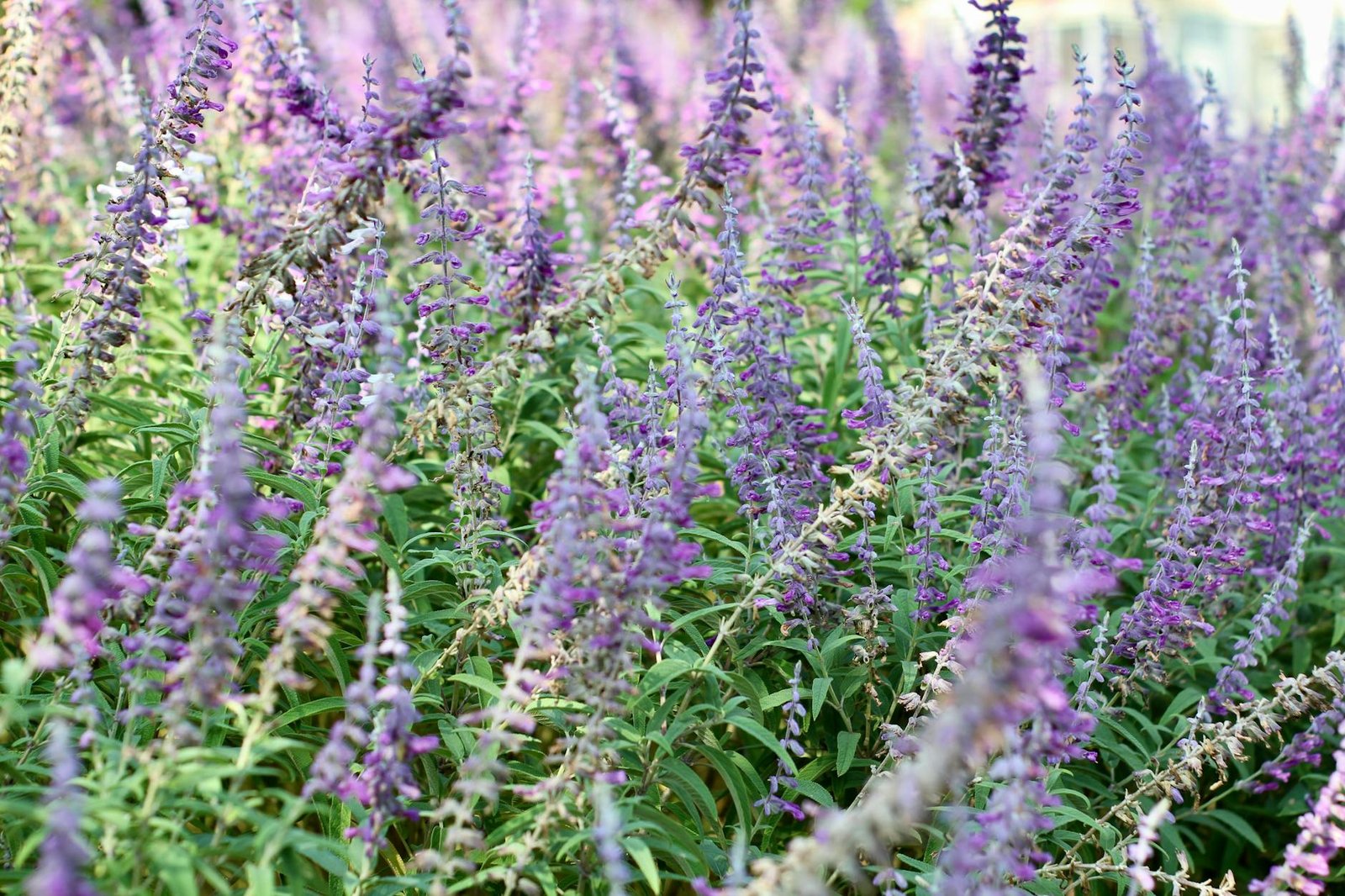
There is a moment every gardener knows… the one at a market where a plant catches your eye and something in you says yes before your brain has offered a single word on the subject. That is how the Russian Sage came home with me last weekend. Silver-green stems, that particular blue that carries its own quiet authority. Heavenly scent. I did not deliberate. I simply picked it up.
What was waiting at home, though I had not planned this ~ was a large blue clay pot I’d left behind during a chaotic move a little over two years ago, and only recently recovered. It had spent that time nested inside a stack of plastic pots, protected, patient. I stood there with the plant in one hand and the pot in front of me and felt the specific satisfaction of two things finding their way to each other. This week I’m cutting thin wood rounds to raise it off the ground for drainage, watching the Salvia settle into a home that was, it turns out, always meant for it.
I looked the plant up afterward, which is how I learned that Russian Sage (Perovskia atriplicifolia) is not a true Salvia in the classical sense, though recent botanical reclassification has been pulling it into the genus. That is how it goes when you pay close attention to plants over a long period of time. They keep offering you something new to revise. At one point in my garden I had twelve Salvia officinalis, a white sage (Salvia apiana), and a rotating cast of others. The bees and hummingbirds treated that garden like their personal infrastructure. They knew what they were doing.
Salvia ~ from the Latin salvare: to save, to preserve, to keep from harm.
The Romans were not naming a plant for the pleasure of naming. They were encoding a verdict into language ~ this is the one that saves you ~ so that the knowledge could not easily be stripped away. The word sage, meaning a person of profound wisdom, shares the same root. That is not coincidence. That is a culture insisting, in the only permanent medium available to it, that this plant and this quality of knowing belonged together.
Years of growing and working with this plant has given me a particular kind of respect for what that etymology is pointing at. The documented medicinal range of Salvia officinalis is extensive and, in many ways, still being mapped. Antimicrobial activity against a meaningful range of pathogens. Neuroprotective compounds ~ rosmarinic acid, ursolic acid, carnosic acid ~ that appear with increasing frequency in brain health research. Significant hormonal activity, particularly relevant across the estrogen-sensitive spectrum of perimenopause and beyond. Documented effects on skin, scalp, and hair follicle health. My husband is in his mid-seventies. He has been getting Sage consistently ~ in his tea, in his shampoo, in his conditioner ~ for some time now. His hair color is slowly returning to red. I am not making claims. I am reporting what I am watching in my own household, over time, with consistent application.
I burn Sage in my space from time to time, and I want to be clear about why: not ritual, not aesthetic atmosphere, not the performance of something ancient. Smoke reaches the three-dimensional geometry of a room in ways a spray cannot ~ the fabrics, the corners, the surfaces with texture and depth. The antimicrobial action does not stop being real because it got wrapped in ceremony at some point in the cultural transmission. What I find worth asking is the reverse: why was a plant with measurable pharmacological action handed down to us primarily wrapped in superstition or reduced to a pinch in a recipe?
Officinalis ~ from officina: the storeroom of a monastery, the place where medicinal preparations were kept, dispensed, and recorded.
When a plant carries this species name ~ and Sage does, along with Rosemary, Lemon Balm, Calendula, and others ~ it was not named for decoration or flavor. It was pharmacopeial. It was kept by people who considered it serious enough to name it after the room where medicine lived. Salvia officinalis: the saving plant of the medicine room. Now look at where you keep it.
“The spice rack is not neutral storage. It is a category assignment.”
There is a real argument to be made ~ I make it at length on Substack ~ that this reassignment was not accidental. That a food and medical system structured around packaged, patented, purchasable solutions has a structural interest in positioning whole plants as peripheral. As folk remedy. As the province of people who are a little behind, a little credulous, a little unscientific. The system needs investment priorities, education funding, and the slow cultural drift of what gets called serious.
What it produces is a population with access to one of the most potent medicinal plants on the planet, using it in quantities calibrated for mildly flavor rather than function.
Growing it right
If you want to work with Sage properly, start with the plant’s actual requirements. Salvia officinalis is Mediterranean in origin, it wants sun, drainage, and to be left alone to establish. It does not want wet feet. A well-draining soil, a position with at least six hours of direct sun, and restraint with the watering can will get you a plant that thrives. In containers, raise it slightly for air circulation around the roots. This is what the wood rounds under the blue clay pot are doing. Prune it after flowering to keep the growth dense rather than woody and leggy. It will reward you with years of reliable production.
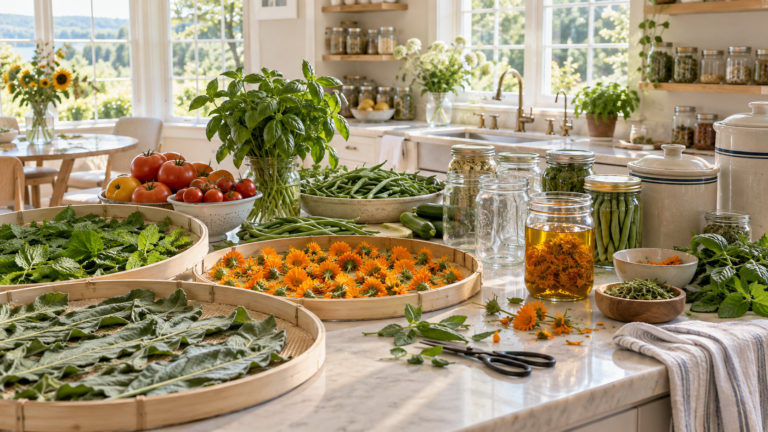
For culinary and medicinal use, harvest in the morning after dew has dried but before the heat of the day drives off the volatile oils. Dry in small bundles hung upside down in a warm, dark, well-ventilated space. Stored in a sealed glass jar away from light, dried Sage holds its potency for a year or more.
Using it in quantities that matter
Here is where the spice rack mentality creates the most practical problem. A pinch of Sage in a sauce does almost nothing physiologically. The amounts that produce the documented effects are larger. And, they are entirely achievable in everyday cooking and preparation if you simply reframe the plant as medicine that happens to taste good, rather than seasoning that happens to have folklore attached.
Culinary-Medicinal Ratios
Fresh Sage in cooking: 6–10 large leaves per serving, added toward the end of cooking to preserve volatile oils. Brown sage butter ~ roughly 8–12 leaves fried in good butter until crisp ~ over pasta, eggs, or roasted squash puts actual therapeutic amounts onto a plate without effort.
Dried Sage in cooking: 1–2 teaspoons per two servings as a baseline. Dried is roughly three times more concentrated than fresh, so less volume, more impact. Combine with fat when possible. The fat-soluble compounds in Sage absorb better with a lipid carrier.
Sage tea (simple infusion): 2 tablespoons of fresh leaf or 2 teaspoons of dried per 8 oz of just-below-boiling water. Steep covered for 10–15 minutes. Cover matters ~ the volatile oils will escape with the steam if you don’t. One to three cups daily for consistent support.
Strong infusion for hormonal support: 4 tablespoons of fresh leaf per 8 oz water, steeped covered for 20 minutes. This is the preparation range used in traditional European practice for hot flash reduction and perspiration regulation. Drink cool or at room temperature, once or twice daily.
Hair & Scalp Applications
Shampoo and conditioner addition: Sage essential oil at 10 drops per ounce of product. Add directly to your current shampoo or conditioner, mix well before each use. Consistent application matters more than concentration ~ this is a daily practice, not a treatment.
Sage hair rinse: Brew a strong infusion ~ 4 tablespoons dried per quart of water, steep 30 minutes covered, strain well. Use as a final rinse after washing. Particularly relevant for gray hair support, scalp health, and oily scalp balance. Store in the refrigerator for up to five days.
Simple Sage Salve
A basic salve puts the antimicrobial and skin-supportive properties into a directly applicable form for minor cuts, abrasions, dry or irritated skin, and lip care.
- 1 cup olive oil infused with dried Sage (fill a jar with dried leaf, cover completely with oil, seal and leave in a warm spot for 4–6 weeks, or gentle heat in a double boiler at very low temperature for 4–6 hours)
- 1 oz beeswax, grated or in pellets
- Optional: 10 drops Sage essential oil added after removing from heat
Strain the infused oil thoroughly. Melt beeswax gently in a double boiler, add strained oil, stir to combine. Remove from heat, add essential oil if using, pour immediately into tins or small glass jars. Allow to set undisturbed. The ratio of beeswax to oil determines firmness ~ more beeswax for a harder salve, less for a softer one. Start with this ratio and adjust to your preference.
Sage Body Lotion Base
For a lighter daily application ~ particularly useful for skin that benefits from the antimicrobial properties without the weight of a salve.
Take an unscented natural lotion base (actually read the label, natural on the front does not necessarily mean natural) and add Sage essential oil at 10 drops per ounce. For a more active preparation, replace up to a third of the liquid component with a cooled strong Sage infusion before emulsifying. This requires a proper emulsifier if you’re making from scratch. But, the simpler route of adding essential oil to a quality unscented base is entirely effective and takes thirty seconds.
None of this is complicated. That is the point. The knowledge required to use this plant well has not been locked away in a laboratory. It has been sitting on a shelf labeled “spice” ~ waiting for someone to pick it up with actual intention.
The Russian Sage waiting to be put into its blue clay pot outside, and the wood rounds will be cut when the rain stops. The drainage is right. I am watching it the way I watch all plants in their first weeks in a new home, with love. There is something about getting a plant right that does not get old, no matter how many years you have been doing it. The right vessel, the right exposure, the right amount of restraint.
That instinct, knowing what something requires before you have language for why, is not superstition. It is the accumulated pattern recognition of someone who has been giving attention for a long time. Trust it. Then build the practice around it.
The longer work lives on Substack.
The cultural machinery that moved these plants from the medicine room to the spice rack ~ how it operates, what it cost us, and what it means to reclaim it ~ that is a full essay. It is where I go deeper on the systems beneath the surface of things.Read it on Substack →
If you’d like to share this piece, please link to it rather than reposting the full text. Linking helps others find the work in its original context and allows it to continue.
Thank you for reading and sharing with care.
If this work resonates with you, consider supporting it with a donation.
Your support helps keep this work going and accessible.