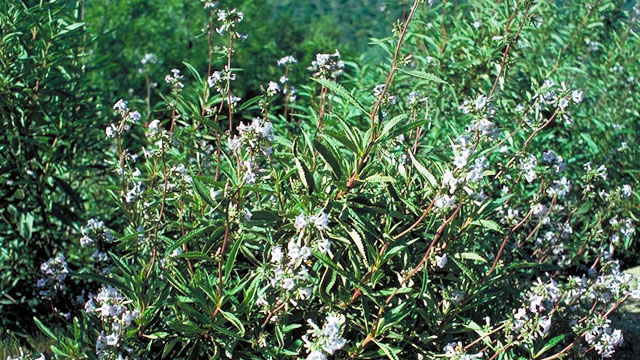
Two weeks in, the yerba santa is still drying in our yurt. Thick, resinous, stubborn. The kind of plant material that refuses to rush. And because the yurt isn’t always warm, because spring in the Northern Sierras is mercurial and the sun doesn’t always cooperate, the process is what it is. Slow. Weather-dependent. Real.
This is what most wildcrafting guides won’t tell you. They’ll give you the Latin name, the harvest window, the medicinal properties. They’ll tell you yerba santa supports respiratory function, clears congestion, carries antimicrobial volatile oils. All true. All useless for harvesting if you don’t know your land.
Because here’s what actually determines whether you find medicine or miss it entirely: microclimate.
The Information That Doesn’t Translate
At 3,000 feet in my region, yerba santa is ready now. I harvested two weeks ago. By the time it’s fully dry and ready to work with, something else will be calling for attention.
At 5,000 feet, it’s weeks behind. The spring arrives slower. The nights stay cooler year-round. Same plant, same region, completely different timing.
This is the gap between information and embodied knowing. Information says “harvest in spring.” Embodied knowing says “harvest when the resin is up but before the volatile oils degrade, which in my microclimate at my elevation means late April, not early May like the book says, and definitely not June like it might be a few ridges over.”
You can read about yerba santa in every wildcrafting manual published. You can memorize its properties, its traditional uses, its botanical family. But unless you know your specific place: the aspect of the slope you’re standing on, how the drainage patterns move, where the frost pockets sit, how elevation shifts timing by weeks ~ you’re working with borrowed knowledge that may or may not apply to the ground under your feet.
Most people think plant knowledge is universal. It’s not. It’s radically local.

Sovereignty Lives in Specificity
This is the part that gets lost when we talk about “reconnecting with nature” or “learning herbalism.” We frame it as acquiring information ~ take a class, read the books, learn the plants. And yes, those things matter. But the authority that actually restores sovereignty? That lives in knowing your land so specifically that you can read what’s happening without having to check the calendar.
You know the microclimate patterns because you’ve watched them for years. You know which plants emerge first after the last frost and which ones lag. You know where the soil stays wet longest and where it drains fast. You know which south-facing slope gets the most sun and which ridgeline catches the wind that dries everything out by mid-summer.
This specificity, this is what was taken. Not just the plant names or the medicinal uses, but the intimate working knowledge of place that made those uses possible. The knowing that you can’t just “learn herbalism” in the abstract. You learn the plants that grow where you are, in the conditions you’re actually living in, with the weather patterns and soil types and elevation realities that shape what’s available and when.
Reclaiming that knowledge means reclaiming relationship with your specific piece of ground. Not “the land” as concept. Your land. The microclimate you inhabit.
Preservation as Practice
And then there’s the slowness of preservation. The part that comes after you’ve sourced something correctly.
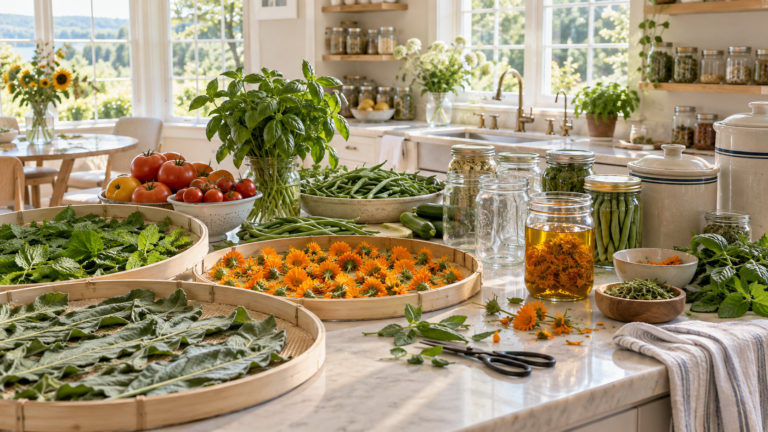
Yerba santa doesn’t dry fast. It’s thick, sticky, full of volatile oils that require time and air movement to concentrate without degrading. In a warm, dry climate, it might take a week. In our yurt, in spring, with weather that swings between sun and rain, it takes longer. I can’t rush it. I can only create the conditions: good air flow, indirect warmth, patience ~ and let the plant do what it does.
This, too, is medicine. Not the end product. The process itself.
Because what you’re actually learning when you harvest and preserve plants is how to work with the material rather than imposing a timeline onto it. You’re learning that some things take the time they take. You’re learning to read dryness by touch and smell rather than by a book’s instruction. You’re building the relationship that makes you capable of working with this plant the next time you require it. Not just as a remedy you buy, but as something you know intimately because you’ve lived with it through its entire transformation from fresh harvest to dried medicine.
Most people want the shortcut. They want the tincture, the capsule, the tea blend someone else formulated. And sometimes that’s the right choice. But what gets lost in that exchange is the knowing. The embodied innerstanding that comes from doing the slow work yourself.
Information says “yerba santa is good for lungs.” Embodied knowing says “I harvested this two weeks ago from the ridge above my place, it’s still drying because it’s thick and the weather’s been cool, and when it’s ready I’ll know because the stems will snap clean instead of bending, and then I’ll work with it the way I’ve learned to work with it, which is specific to how it grows here and how my body responds to it and what I’ve observed over years of actually using it.”
That’s the difference. That’s what can’t be outsourced.

The Real Teaching
Yerba santa teaches this clearly because it’s not subtle. Get the timing right ~ know your microclimate, watch for the signs, harvest when the plant is at peak potency ~ and you have medicine. Miss it, and you’re working with something less effective. The plant doesn’t care if you read the book. It cares if you know the land.
This is the pattern beneath all plant sourcing, all wildcrafting, all the work of reclaiming ancestral intelligence. It’s not about collecting information. It’s about building relationship. With place. With plants. With the seasonal rhythms and microclimate realities that shape what’s possible in your specific location.
You can’t learn that from a manual. You learn it by giving attention. By watching what happens year after year. By making mistakes: harvesting too early, too late, in the wrong conditions ~ and adjusting. By letting the land teach you what it knows.
And the land knows a lot. It just doesn’t speak in abstractions.
Where This Leads
If you’re reading this and something clicks ~ if you’re tired of generic plant knowledge that doesn’t translate to your actual life, if you want to build real competence with the plants and patterns in your specific place, if you’re ready to trade information for embodied knowing ~ that’s the work we’re doing in the NaturWise Living community.
As a practice. Real people, real places, real observations about what actually works where they are. The kind of collective intelligence that builds when people stop performing expertise and start sharing what they’ve learned from the ground they stand on.
The conversation is happening now. The land is ready to teach you. The question is whether you’re ready to learn its specific language.
For a deeper exploration of what it means to reclaim sovereignty through place-specific knowing, and how this connects to larger patterns of cultural restoration, read the full essay on Substack.

Continue the Conversation
NaturWise Living Skool is a free community for those building a natural lifestyle ~ from seed to table ~ through organic living, permaculture, and herbal health, without overwhelm or the requirement to homestead.
It’s a space for learning slowly, asking questions, and reconnecting with seasonal and earth-based ways of living.
→ Join NaturWise Living Skool
If this work resonates with you, consider supporting it with a donation.
Your support helps keep this work going and accessible.
If you’d like to share this piece, please link to it rather than reposting the full text. Linking helps others find the work in its original context and allows it to continue.
Thank you for reading and sharing with care.