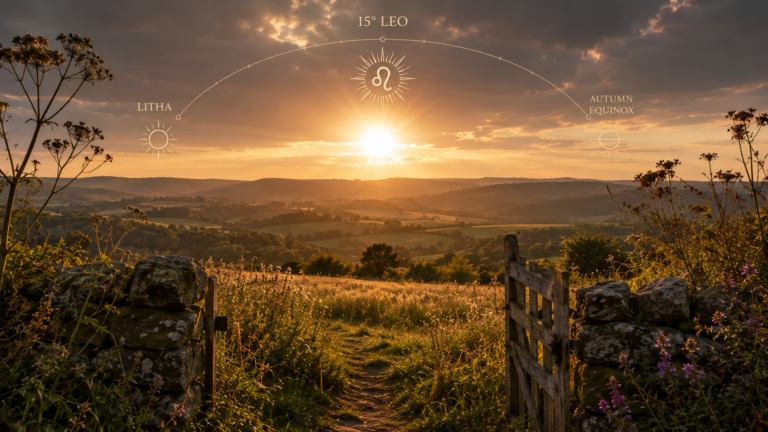
This year, something rare is happening.
The second full moon after the Spring Equinox ~ the traditional timing for Beltane across Celtic regions lands precisely on May 1st. The lunar calculation and the modern calendar date converge. What’s usually separated by days or even weeks aligns perfectly.
This matters because Beltane marks one of the most significant thresholds in the seasonal wheel: the moment when what you’ve been tending can now sustain itself.
Not the beginning of growth. Not the calibration midpoint. The transition from preparation to abundance, from constant intervention to trusted momentum, from fragile emergence to vigorous expression that can withstand stress.
In agricultural terms, this is when you stop hovering over seedlings and let the plants do what they’re designed to do. In energetic terms, this is when you recognize that what you built in late winter and calibrated at the equinox is now strong enough to carry its own weight.
The work isn’t over. But the quality of the work fundamentally shifts.

The Natural Reality of Late Spring
By early May in the Northern Hemisphere, the landscape broadcasts a clear message: we have crossed into the safe zone.
Frost risk is definitively past in most temperate regions. Soil temperatures have stabilized in the range where seeds germinate reliably and root systems expand without stress. The plants that emerged tentatively in March are now growing with visible vigor ~ adding height, branching, flowering, filling space.
For traditional pastoral communities, this threshold was critical: livestock are ready for summer pasture. Birthing is complete. Young animals are strong enough to handle dispersal. Forage is abundant enough to sustain herds without supplemental feeding. The winter’s stored hay is nearly exhausted, and that timing is perfect ~ because the land can now provide.
Pollinators are everywhere. Bees, butterflies, early moths, hoverflies. The air itself feels fuller, warmer, more alive. This isn’t the tentative stirring of early spring. This is momentum.
What this means functionally: systems can now self-regulate. They still need monitoring, still benefit from support, but they no longer require constant intensive intervention to survive.
That shift ~ from “will this make it?” to “this is thriving” ~ is what Beltane marks.

Why Fire? The Functional Logic
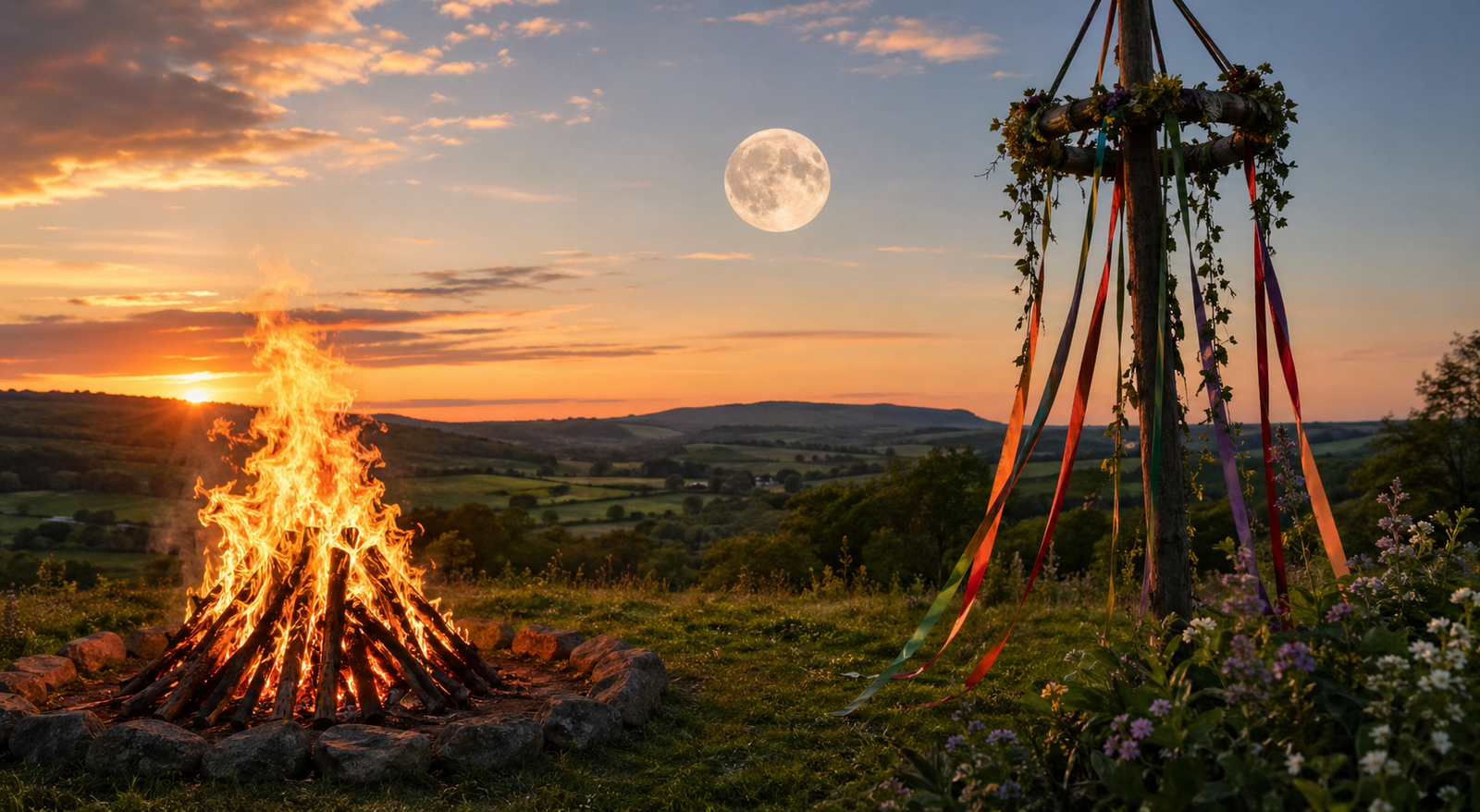
Across European traditions, Beltane was observed with fire. Cattle were driven between two fires before being moved to summer pasture. Communities gathered around bonfires on hilltops. Germanic Walpurgis Night featured protective flames. Scandinavian traditions lit fires to mark the passage into summer.
Why fire specifically?
Purification: Smoke cleanses livestock, people, fields. In practical terms, certain plant smokes (juniper, mugwort, birch) have antimicrobial properties. Driving animals through smoke before dispersing them to pasture reduced disease transmission ~ empirical veterinary practice encoded in ritual.
Protection: Fire creates a symbolic boundary. As animals move from the controlled space of winter shelter to the open abundance of summer pasture, passing through fire marks the transition. You’re sending them out with your best knowledge and whatever protection you can offer.
Transformation: Burning winter’s remnants ~ dead wood, cleared brush, last year’s growth ~ creates ash that fertilizes fields and creates literal space for new growth. Fire transforms what’s complete into nourishment for what’s emerging.
Community coordination: A bonfire is a gathering point. In a landscape where herds will soon disperse across summer pastures, fire brings people together to coordinate timing, share resources, mark the threshold collectively.
The “pagan fire festival” was practical seasonal management combined with community organization. The ritual encoded the knowledge: this is when it’s safe to disperse, this is how you protect what you’re releasing, this is how you mark the transition from protection to trust.

The Lunar Timing: Full Moon, Not New
Imbolc was timed to the second new moon after Winter Solstice. Hidden preparation. Planting in the dark. Potential not yet visible.
Beltane is timed to the second full moon after Spring Equinox. Maximum illumination. What’s grown is now undeniably visible. Celebration of what can be seen.
The pattern reveals the logic: new moon for inward work, full moon for outward expression.
This year, that full moon lands on May 1st ~ the modern calendar date for May Day. Usually these are separated. The lunar calculation responds to actual seasonal conditions, shifting earlier or later depending on when the equinox occurs. The calendar date stays fixed regardless of what’s happening in the landscape.
Their convergence this year creates unusual clarity. The astronomical marker and the cultural marker align. The threshold is emphatic.

From Seasonal Celebration to Workers’ Rights
May Day carries a dual identity that most people don’t connect: ancient agricultural threshold AND international workers’ holiday.
How did a fire festival about livestock become a day for labor rights?
The connection is deeper than it appears. Both are about recognizing when you have enough abundance to celebrate and rest.
Agriculturally: we’ve passed the danger zone. Growth is self-sustaining. We can ease the constant vigilance and trust the momentum we’ve built.
Economically: we’ve created enough wealth. Workers deserve rest, leisure, celebration ~ not just endless extraction of their labor.
The pattern that got labeled “pagan celebration” was autonomous knowledge of when to stop intensive labor and allow natural abundance to unfold. That knowledge ~ knowing when you have enough, knowing when systems can self-regulate ~ is structurally threatening to systems that require constant productivity regardless of seasonal rhythm or human capacity.
The suppression of Beltane as “pagan” and the later reclamation of May Day as workers’ rights follow the same logic: autonomous knowledge of when to rest becomes political.

What This Threshold Actually Means
In practical terms, Beltane asks: Can you recognize when what you’ve built is strong enough to sustain itself?
This is harder than it sounds. We tend to oscillate between two extremes:
Eternal intervention: Continuing to tend intensively long past the point where the system can self-regulate. Hovering. Over-managing. Unable to trust what we’ve created.
Premature abandonment: Pulling back too soon, before the system has developed enough resilience. Mistaking fragile emergence for established strength.
The threshold is the sweet spot between these. Knowing when to shift from intensive cultivation to responsive maintenance. Recognizing the difference between “needs constant support to survive” and “benefits from occasional support but can sustain itself.”
This applies to gardens. To projects. To relationships. To businesses. To personal practices.
The question Beltane poses: Where in your life are you still hovering when you could be trusting? Where have you abandoned what still needs support? Where is the actual threshold between these?

Marking the Threshold: Celebration and Practice
If you want to acknowledge this threshold ~ whether you call it Beltane, May Day, or simply “late spring abundance” ~ here are practices that honor both the celebratory and practical dimensions:
Fire practices (safely and legally):
- Small contained fire for releasing what’s complete
- Candle lighting with intention for what’s self-sustaining now
- Smoke cleansing with sacred herbs (mugwort, juniper, rosemary, cedar)
- Even striking a match and watching it burn can mark the threshold symbolically
Seasonal observation:
- Walk your landscape (yard, neighborhood, park) and notice what’s thriving without constant intervention
- Identify: what still needs support vs. what’s self-regulating now?
- Assess your own tendency: are you over-tending? Under-tending? Or recognizing the threshold accurately?
Celebration of what earlier preparation made possible:
- First harvest of perennial herbs, early greens, spring flowers
- Community gathering: potluck, fire circle, outdoor meal with people you’ve been building with
- Acknowledging aloud: this abundance didn’t appear spontaneously ~ it follows from what we planted, tended, and calibrated
Practical seasonal tasks:
- Thinning is mostly complete now. Shift to maintenance rather than intervention.
- Mulching to support self-regulation: moisture retention, weed suppression, temperature moderation
- Set up systems that reduce need for constant input: drip irrigation, companion planting, support structures
- For those with livestock: final health checks before pasture dispersal
The point isn’t to perform historical ritual. The point is to recognize a real threshold in natural systems and mark it consciously in your own life.

The Invitation
This week, as the full moon rises on May 1st in a convergence that won’t repeat for years, I invite you to notice: What have you been tending that is now strong enough to sustain itself?
Not what needs to begin. Not what needs more pushing. What’s ready to shift from your intensive intervention to its own momentum.
Where can you ease the constant vigilance and trust what you’ve built?
This isn’t abandonment. It’s recognition. The work continues, but the quality of attention changes. From anxious hovering to confident maintenance. From “will this survive?” to “this is thriving.”
Beltane marks the threshold when preparation transitions to abundance. When what you planted in the dark of late winter, calibrated at the spring balance point, now expresses itself with vigor that no longer requires your constant protection.
The fire festivals weren’t just mysticism. They were communities marking a real ecological transition and coordinating their response to it. Recognizing together: we can trust this now. We can celebrate. We can rest from the intensity of early season work because what we’ve built is strong enough.
Welcome to the threshold of self-sustaining growth. May you recognize what’s ready to carry its own weight, release what’s complete, and celebrate the abundance that emerges when right timing meets disciplined preparation.
What are you tending that’s now strong enough to sustain itself? Where are you still hovering when you could be trusting? Share your reflections below.
This article explores Beltane as the threshold of self-sustaining growth, using this year’s rare lunar-calendar convergence as anchor. For those wanting deeper exploration ~ including the evolution of May Day from agricultural to political, cross-cultural fire traditions and their functional logic, the relationship between lunar cycles and seasonal thresholds, and frameworks for recognizing self-sustaining systems in your own life ~ the extended version is available here.
If you’d like to share this piece, please link to it rather than reposting the full text. Linking helps others find the work in its original context and allows it to continue.
Thank you for reading and sharing with care.

Continue the Conversation
NaturWise Living Skool is a free community for those building a natural lifestyle ~ from seed to table ~ through organic living, permaculture, and herbal health, without overwhelm or the requirement to homestead.
It’s a space for learning slowly, asking questions, and reconnecting with seasonal and earth-based ways of living.
→ Join NaturWise Living Skool
If this work resonates with you, consider supporting it with a donation.
Your support helps keep this work going and accessible.