
The other day, a woman asked me, “What is compost?”
Not how to compost. Not where to find composting resources. But what it actually was. She had no conceptual framework for it whatsoever. And honestly? It stopped me in my tracks.
Here in California, where sustainability buzzwords float through conversations like pollen on the wind, I’d assumed everyone at least knew the term. But her genuine curiosity revealed something far more significant than a personal knowledge gap; it illuminated how profoundly disconnected our culture has become from Earth’s most fundamental process: transformation through decay.
That conversation is why you’re reading this now. Because, if we’ve lost the language for nature’s original recycling system, we’ve lost something essential about our place in the living world.
What Compost Actually Is (And Why Most Explanations Miss the Point)
Let’s start with etymology. The word “compost” comes from the Latin componere: meaning “to put together.” Not to throw away. Not to dispose of. To assemble into something new.
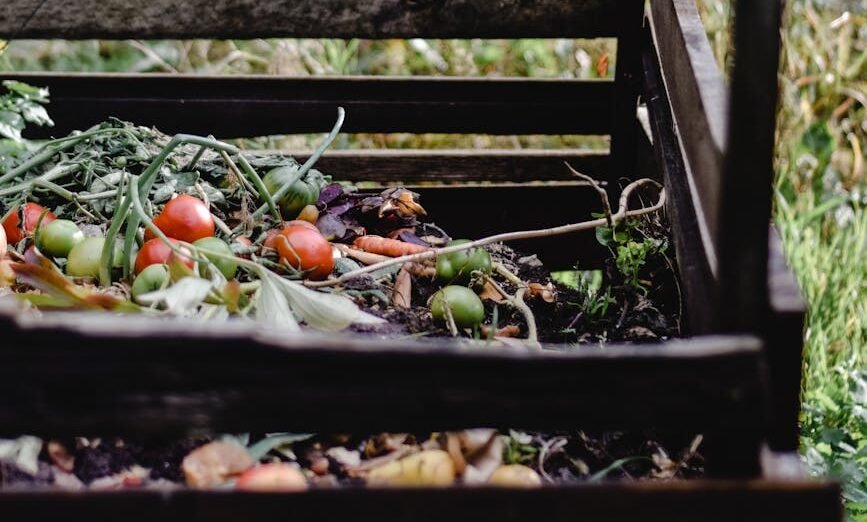
Compost is decomposed organic matter that has been transformed by an invisible workforce of microorganisms, fungi, and bacteria into nutrient-rich soil amendment. But that clinical definition misses the magic entirely.
Here’s what composting really is:
It’s participating in Earth’s alchemical process of turning death into life.
Every apple core, every eggshell, every autumn leaf contains the building blocks of future forests, gardens, and food systems. In nature, there is no such thing as waste; only matter in transition between forms. A fallen tree becomes mushroom food. Mushroom mycelium breaks down into nutrients. Those nutrients feed new saplings. The cycle continues, unbroken, for millions of years.
Modern waste systems have severed this loop. We’ve created a linear system ~ extract, consume, discard ~ that fundamentally contradicts how living systems actually function. When you send organic matter to a landfill, it doesn’t decompose properly. Instead, it produces methane, a greenhouse gas 25 times more potent than carbon dioxide. We’ve literally criminalized nature’s most elegant solution.
What I’ve observed is this: the moment people understand composting, they can’t unsee the absurdity of treating living matter like garbage. It’s a doorway into systems thinking that changes everything downstream.

The Situation: Why Your Kitchen Scraps Matter More Than You Think
Consider the etymology of “waste”: from the Latin vastus, meaning “empty, desolate, uncultivated.” Our language reveals our assumptions: we’ve decided certain materials are empty of value. Nature disagrees.
Every year, Americans send 30-40% of our food supply to landfills. That’s not just lost food; it’s lost soil fertility, lost carbon sequestration potential, lost opportunities to close nutrient cycles. From a systems perspective, this is like drawing blood from your body and pouring it down the drain instead of allowing your circulatory system to recirculate it.
Your kitchen generates between 200-400 pounds of compostable material annually. That’s enough to amend dozens of square feet of garden beds, nourish countless container plants, or rebuild degraded soil structure in your neighborhood.
But here’s where it gets interesting: composting offers triple-tier benefits that operate on completely different scales.
- The environmental gift: You’re reducing methane emissions, building soil water retention (critical during droughts), and sequestering atmospheric carbon in stable organic matter.
- The personal empowerment: You’re reclaiming agency over your ecological footprint. Every banana peel becomes a tangible act of participation rather than abdication.
- The spiritual reconnection: You’re bearing witness to transformation itself. You’re dissolving the illusion that anything is ever truly “finished” or “useless.” You’re remembering that you, too, are part of these cycles.
I’ve watched people in pure joy while holding finished compost in their hands ~ rich, dark, earth-smelling ~ because something in their nervous system recognizes coming home.
The Task: Three Pathways to Begin (No Matter Where You Live)
Here’s the beautiful secret: you don’t have to have acreage, expensive equipment, or horticultural expertise. You require only willingness to close a loop that modern life has artificially opened.
Method 1: Countertop Composting for Small Spaces
For apartment dwellers, small kitchens, or anyone who wants to start small, countertop composting is your gateway. The most beginner-friendly approach uses a sealed Bokashi bucket ~ a Japanese fermentation method that pickles food scraps using beneficial microorganisms.
What makes this work: You’re creating an anaerobic (oxygen-free) environment that prevents odors and pests. Add scraps daily, sprinkle with Bokashi bran (inoculated with microbes), seal tightly. In 2-4 weeks, you’ll have pre-compost ready to bury in soil or add to outdoor systems.
The key principle: Everything stays contained. No fruit flies. No smells. Just quiet transformation happening in a 5-gallon bucket under your sink.
Actionable insight: Start with one bucket. When it’s full and fermenting, begin filling a second. By the time bucket two is full, bucket one is ready to use. This creates a perpetual cycle with minimal effort.
Method 2: Outdoor Bin or Pile Composting
For those with yards, balconies, or shared outdoor spaces, traditional composting offers the most volume capacity. You can purchase a tumbler bin or simply create a 3-foot cube pile in a corner of your yard.
The brown-green balance made simple: Think of it as carbon (browns: dried leaves, cardboard, paper) + nitrogen (greens: food scraps, grass clippings, coffee grounds) + water + air = transformation. Aim for roughly 3 parts brown to 1 part green by volume.
What I’ve observed: People overcomplicate this. Nature wants to compost. Your job is simply to create favorable conditions and then get out of the way.
Pest prevention: Bury food scraps in the center of the pile under 4-6 inches of brown material. Don’t add meat, dairy, or oils. Keep the pile as moist as a wrung-out sponge. That’s it.
Method 3: Vermicomposting (Worm Composting)
I love this one for its sheer elegance. Red wiggler worms consume organic matter and excrete castings; the richest, most biologically active compost you can create.
Why worms are allies: They process waste quickly (eating up to their body weight daily), operate silently indoors, and produce castings that contain 5-11 times more available nutrients than ordinary soil.
The setup: A plastic bin with drainage holes, bedding (shredded newspaper or coconut coir), a pound of red wigglers (about 1,000 worms), and your kitchen scraps. Keep it in a cool, dark place. Harvest finished castings every 3-4 months.
The revelation: Watching worms transform coffee grounds into black gold creates an almost meditative practice. You’re not just composting; you’re stewarding a living system.

The Obstacle: Confronting the Pest Problem That Prevents Most People From Starting
Let’s address the fear head-on: What about flies? Rodents? Smells?
Here’s the contrarian truth: a healthy compost system doesn’t attract pests; it creates balance.
Problems arise from imbalance. Fruit flies appear when fresh scraps sit exposed on the surface. Rodents investigate when meat or dairy is included. Odors develop when ratios skew too wet or too nitrogen-heavy.
The universal principles that prevent issues across all three methods:
- Cover fresh additions: Bury food scraps under browns in outdoor piles, seal tightly in Bokashi buckets, ensure worm bins have adequate bedding covering scraps
- Maintain moisture balance: Too wet creates anaerobic conditions (and smells), too dry halts decomposition
- Avoid animal products: No meat, dairy, bones, or oils: these attract scavengers and decompose poorly. Exception: I have seen one man get by with collecting roadkill and adding it. However, he had a long temperature gauge in his pile and kept it very hot. So, he would bury the carcass in the center, and had no problems.
- Create airflow: Outdoor piles benefit from occasional turning, worm bins must have ventilation holes
What I’ve learned through over 2 decades of composting: when you work with natural systems rather than against them, they self-regulate beautifully.
The Resolution: Completing the Circle
The word “humus” (finished compost’s technical name) shares roots with “human” and “humble” ~ all from the Latin humus, meaning “earth” or “ground.” We are literally made of the same stuff we’re returning to the soil.
How to know your compost is ready: It smells like forest floor after rain. It’s dark, crumbly, and unrecognizable from its original ingredients. It feels alive in your hands because it is ~ teeming with beneficial microorganisms.
Now comes the sacred part: the return.
- For windowsill herbs: Mix one part compost to three parts potting soil. Your basil will explode with vitality.
- For balcony containers: Top-dress existing plants with an inch of compost, or mix it into soil when planting new containers.
- For garden beds: Spread 1-3 inches across the surface and let earthworms incorporate it, or work it gently into the top few inches of soil.
- For abundance overflow: Share with neighbors, donate to community gardens, or offer to local gardeners. Compost is a gift that regenerates the gift-giver.
This is the moment when your kitchen scraps complete their transformation: when orange peels become oregano, when coffee grounds become cucumbers, when you tangibly close a loop that connects your breakfast table to the web of life.

The Yield: What Changes When You Begin
Here’s what I haven’t mentioned yet: composting changes how you see everything.
You’ll notice you’re generating less actual waste. You’ll become curious about where things come from and where they go. You’ll start questioning other artificial separations in modern life. You’ll feel the dissonance when you’re traveling and have to throw compostable materials in the trash.
This is the real yield; not just the finished compost, but the shift in consciousness that comes from participating in transformation.
From a systems perspective, composting is training wheels for understanding how everything connects. Today it’s banana peels becoming soil. Tomorrow it’s recognizing that communities operate like ecosystems, that healing works through cycles of integration rather than elimination, that nothing is ever truly separate from anything else.
You’ll start seeing the world through nature’s eyes: elegantly connected, perpetually regenerating, waste-free by design.
Your Next Step: Begin Today
You don’t have to wait for the perfect system, ideal conditions, or complete knowledge. Start where you are with what you have.
- If you’re in an apartment: order a Bokashi bucket this week.
- If you have a yard: designate a 3-foot square area and start a pile with your next meal’s scraps covered by fallen leaves.
- If you’re curious about worms: a basic worm bin costs less than $30 to set up.
The earth doesn’t require your perfection. It requires your participation.
If this small practice of composting has awakened your curiosity about reconnecting with natural rhythms, healing through nature’s wisdom, and understanding the deeper patterns that sustain all life, I invite you to explore the Nature Wise Living School community.
We dive deeper into the intersections of herbalism, permaculture, and frequency work; not as separate disciplines, but as integrated pathways back to our belonging within nature’s intelligence. Because once you begin closing one loop, you’ll want to discover all the others waiting to be remembered.
The earth has been composting for 400 million years.
Your kitchen scraps are just waiting to come home.