
What if I told you that the story of Christmas ~ the one you’ve celebrated your entire life ~ is far older and stranger than you’ve been led to believe?
Not in the way some people want you to think. Not as some grand deception or proof that your faith is built on lies. But as something far more beautiful: a convergence point where human longing, ancient wisdom, and sacred mystery meet in the longest night of the year.
This isn’t about debunking Christianity or reducing your traditions to “just paganism.” It’s about understanding how our ancestors ~ separated by thousands of miles and wildly different worldviews ~ all reached toward the same fundamental truth when darkness threatened to consume them: light returns. Life renews. We are not abandoned.
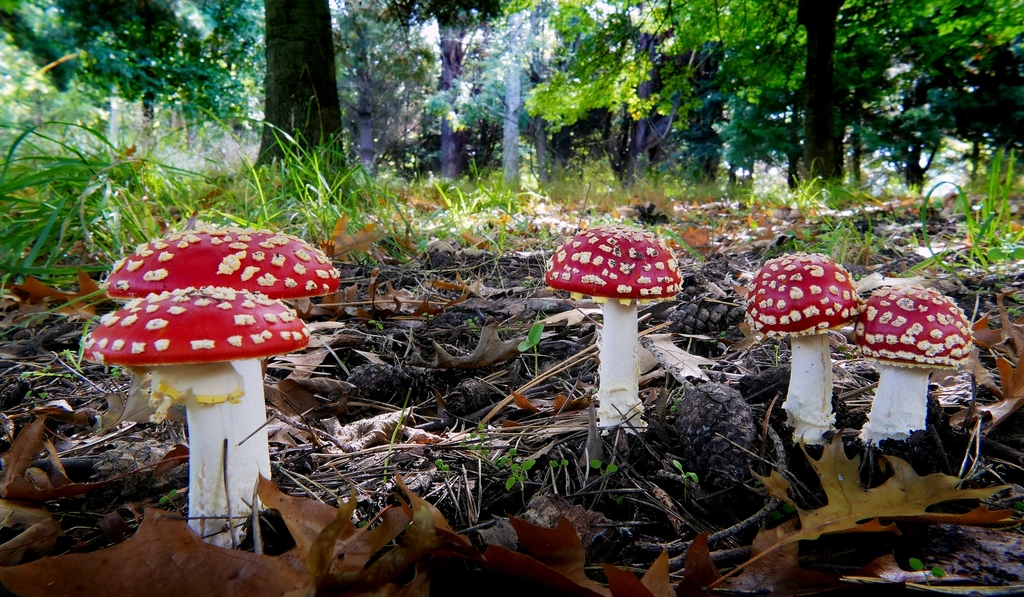
And sometimes, that truth came through the most unexpected messenger: a bright red mushroom growing beneath an evergreen tree in the snow.
When Darkness Becomes Unbearable: The Human Crisis of Winter
Here’s what I’ve observed working with people across spiritual traditions: we’ve lost our visceral understanding of what winter solstice actually meant to our ancestors.
We flip a switch. Light floods the room. We adjust the thermostat. We order groceries to our door. The sun sets at 4:47 PM and we… barely notice.
But imagine ~ truly imagine ~ watching the sun retreat a little more each day. Watching the world die around you. Feeling your own body slow, your mood darken, your energy drain as the light disappears. With no certainty it would ever return.
This wasn’t metaphor. This was survival-level terror.
The winter solstice represented the thinnest point between life and death, the moment when the cosmic order itself hung in the balance. Every culture that experienced deep winter developed rituals not just to mark this moment, but to actively participate in calling the light back. Because psychologically, spiritually, physiologically, we had to believe we had some agency in the return of life itself.
This is the context in which both shamanic plant rituals and the celebration of Christ’s birth emerged. Not as competing narratives, but as different cultural responses to the same existential crisis.

The Red and White Messenger: Amanita Muscaria’s Symbolic Language
Walk through a northern European forest in late autumn or early winter, and you’ll find them: brilliant red caps dotted with white, pushing up through snow at the base of pine and birch trees. Amanita muscaria, the fly agaric mushroom, looks like it was designed by a children’s book illustrator. Or perhaps our collective imagination was shaped by thousands of years of seeing exactly this image.
The mycorrhizal relationship here is crucial. These mushrooms don’t just randomly appear near evergreens; they’re in actual partnership with the trees, their mycelial networks intertwined with root systems in a symbiotic exchange. The mushroom gives the tree access to nutrients; the tree provides sugars. Life supporting life in the dead of winter.
This visual and biological relationship would not have been lost on indigenous peoples who observed nature with the intensity required for survival. The red and white mushroom beneath the green tree wasn’t just pretty; it was a sign, a marker, a sacred intersection of forces.
And then there were the effects.
When the Veil Grows Thin: Shamanic Plant Mysticism in Siberian Cultures
The ethnographic record is clear: Siberian, Finno-Ugric, and other northern Eurasian peoples used Amanita muscaria ceremonially for thousands of years. Not recreationally. Not casually. But as a sacrament: a tool for shamans to cross between worlds, to communicate with spirits, to bring back healing and wisdom for their communities.
The experiences were consistent across cultures: sensations of flight, of expansion beyond the body, of time becoming fluid. Vivid imagery. Encounters with beings or forces that felt more real than ordinary reality. A sense of cosmic perspective that dissolved the boundary between self and nature.
What I find fascinating is how these cultures interpreted these experiences. They didn’t say “I’m hallucinating” or “this is just my brain misfiring.” They said: “I am traveling. The spirits are showing me truth. The mushroom is a door.”
The shaman’s red and white ceremonial attire wasn’t costume ~ it was identification with the sacred messenger that allowed passage between realms. The medicine person became, in essence, the living embodiment of the mushroom’s gift: bringing light and wisdom from another world into this one.
Sound familiar?

The Reindeer, the Flight, and the Sacred Partnership
Here’s where it gets delightfully weird.
Reindeer, those same animals that would later pull a certain gift-bringer’s sleigh, are known to seek out and consume Amanita muscaria. Researchers have documented them pawing through snow to find the mushrooms, exhibiting unusual behaviors afterward: erratic movements, strange vocalizations, what certainly looks like altered consciousness.
Indigenous peoples observed this. They observed that reindeer who consumed the mushrooms might exhibit behaviors that resembled… well, flight might be too strong a word. But certainly something beyond ordinary reindeer activity.
The mythology of flying reindeer likely emerged from generations of watching this sacred animal-plant relationship and weaving it into the larger cosmology of shamanic journey work. The shaman flies. The reindeer flies. The boundary between human, animal, and spirit becomes permeable in the liminal space of winter solstice ritual.
This wasn’t primitive superstition. This was sophisticated observation woven into a coherent worldview where every element of nature participated in a sacred pattern.
Chimneys, Hearths, and the Architecture of Transformation
Now we get to the practical magic that preserved these symbols in our cultural memory.
In deep winter, when snow piled high around dwellings, the smoke hole or chimney often became the primary entrance and exit. This wasn’t quirky, it was necessity. And it created a powerful symbolic tableau: the shaman, dressed in red and white, carrying gifts of healing and vision, entering the home through the chimney to gather around the hearth.
But there’s another detail ethnographic accounts preserve: mushrooms were often dried by stringing them and hanging them near the fire or even in large socks by the hearth. This served the practical purpose of preservation and preparation, but it also created an unmistakable visual that would echo through centuries.
The hearth was never just a heat source; it was the sacred center of the home, the point where transformation occurred. Raw food became nourishment. Cold became warmth. And in shamanic contexts, plant matter became portal to the divine.


The Evergreen Tree as Bridge Between Worlds
In the cosmology of almost al, if not all, ancient cultures, the World Tree stands at the center of reality ~ its roots in the underworld, its trunk in the middle world where humans dwell, its branches reaching into the heavens. The shaman climbs this tree in vision to travel between realms.
The evergreen ~ the pine, the fir, the birch ~ represented this axis mundi in the physical landscape. And at its base grew the red mushroom, marking the threshold, the doorway, the place where worlds meet.
When we bring an evergreen tree into our homes and decorate it with lights and precious objects, we’re unknowingly recreating an altar to this ancient cosmology. The tree isn’t decoration; it’s a vertical path, a sacred marker, a reminder that we dwell in multiple dimensions simultaneously.
The lights we string on it? Those are the stars the shaman sees when traveling the World Tree. The gifts beneath? Those are the offerings made at the threshold between worlds. The star on top? That’s the celestial realm the shaman seeks to access.
Every element maps onto the shamanic journey; we’ve just forgotten how to read the language.
From Shaman to Saint: The Metamorphosis of the Gift-Bringer
So how did a Siberian mushroom shaman become Saint Nicholas become Santa Claus?
Not through straight-line transmission, but through something more organic: the archetypal figure of the winter gift-bringer appears across cultures because it answers a universal human need. Someone who brings light to darkness. Healing to sickness. Abundance to scarcity. Hope to despair.
Saint Nicholas of Myra ~ a real 4th-century Christian bishop known for his generosity ~ became the carrier for this archetype in Christian culture. The historical Nicholas might have known nothing of mushroom shamanism. But the stories that accumulated around him, the imagery that became inseparable from his legend: red and white, winter journey, gift-giving, magical transportation; these drew from the deeper well of northern European folk memory.
The red suit wasn’t invented by Coca-Cola in 1931, as many believe; it was already embedded in the iconography centuries earlier, pulling from sources both Christian and pre-Christian.
This is how culture works: it doesn’t erase; it layers. It doesn’t replace; it reinterprets. The shaman becomes the saint becomes the secular symbol, each iteration preserving something essential while adapting to new contexts.

Christianity’s Encounter with the Solstice: Convergence, Not Conspiracy
Here’s where we need to get honest about history without falling into reductionism.
Jesus of Nazareth was almost certainly not born on December 25th. Early Christians knew this. The date was chosen, likely in the 4th century, to coincide with existing solstice celebrations: the Roman Sol Invictus, the Germanic Yule, the broader pagan festivals of light’s return.
Pagan originally meant country dwellers
Was this cultural theft? Cynical appropriation?
From a systems perspective, it was something more nuanced: Christianity recognized that certain moments in the human experience are inherently sacred, regardless of religious framework. The winter solstice was already holy. Not because pagans made it so, but because the human psyche and the cosmic order converge there in a way that demands ritual acknowledgment.
Rather than fighting this, early Christianity chose to baptize it; to say “yes, this moment matters, and here’s how it reveals the truth of Christ.”
This wasn’t erasure. It was conversation. It was translation. It was recognizing that the longing for light in darkness is universal, even if different traditions name that light differently.
From Plant Sacrament to Living Logos: The Shift in Mediation
Here’s the theological heart of the matter, and it’s more profound than most “Christmas has pagan origins” discussions acknowledge.
Pre-Christian shamanic traditions used plants as mediators: substances that opened doors, facilitated encounters, enabled travel between worlds. The mushroom, the sacred herb, the vision-inducing root; these were methodes of transcendence, tools that temporarily dissolved the boundary between human and divine.
Christianity made a radical claim: the mediator is no longer a substance but a person. Not a plant but the Logos made flesh. Not a temporary dissolution of boundaries but a permanent bridge between heaven and earth.
Christ as “Light of the World” isn’t random poetry; it’s the Christian answer to the same question shamanic cultures asked: How do we survive the darkness? How do we access the divine? How do we find our way home?
The shamanic answer: through the red mushroom, through the journey, through temporary union with cosmic consciousness.
The Christian answer: through the being of Christ, through faith, through permanent relationship with the divine made accessible.
These aren’t the same answer. But they’re answering the same question.
The Universal Story: Death, Descent, and Resurrection
What I’ve observed across wisdom traditions is that certain narrative structures repeat not because cultures borrowed from each other, but because they reflect something true about reality itself.
The pattern shows up everywhere: descent into darkness, confrontation with death, emergence transformed. Inanna’s descent to the underworld. Persephone’s seasonal journey. The shaman’s initiatory death and rebirth. Christ’s crucifixion and resurrection.
This isn’t coincidence or plagiarism; it’s the human psyche recognizing and retelling the fundamental pattern of transformation. Everything that truly changes must first die. Everything that renews must first descend. Everything that rises must first surrender.
The winter solstice is this pattern written into the cosmos. The sun dies, or appears to, then returns stronger. Nature surrenders to death, then explodes into new life. We face our own darkness, our own mortality, and either break or break through to something larger.
Christianity didn’t invent this pattern. But it claimed, and claims, to be the ultimate fulfillment of it, the moment when the pattern became personal, when the cosmic cycle entered human history in irreversible form.


Why the Mushroom Faded and the Symbol Remained
So if these connections are real; if Christmas really does sit at this convergence of mushroom mysticism and solstice ritual and Christian theology, why don’t we all know about it?
Several forces converged over centuries:
Institutional religion standardized and sanitized. As Christianity became the dominant culture rather than a countercultural movement, it needed clear boundaries, orthodox practices, approved narratives. The messy, earthy, plant-involved origins of many folk customs didn’t fit the institutional image.
Ritual literacy was lost. When you’re living close to the land, observing mushrooms and reindeer and the daily retreat of sunlight, the symbolic connections remain alive. When you move to cities, adopt industrial time, disconnect from natural cycles; the symbols persist, but their living meaning fades.
Cultural memory preserved story over practice. We kept the images ~ the red and white, the tree, the gifts, the chimney ~ but forgot what they once pointed toward. They became decoration rather than doorway.
This happens with all living traditions over time. The form outlives the function. The ritual outlives the revelation.
The Modern Christmas: Ghosts of Meaning We Can No Longer Name
Walk through any shopping mall in December and you’ll see it: the entire archetypal tableau, perfectly preserved and completely misunderstood.
Santa in his red suit (the shaman, the saint, the gift-bringer). The reindeer in flight (the sacred animal partnership, the shamanic journey). The decorated tree (the World Tree, the axis mundi, the bridge between realms). The lights everywhere (the return of the sun, the triumph over darkness, the cosmic order restored). The gifts (the offerings, the abundance, the treasures brought back from the spirit world).
We’ve kept every element of the ancient pattern while forgetting entirely what it means.
The commercialization of Christmas isn’t just capitalism run amok ~ it’s what happens when sacred symbols become untethered from sacred context. We still feel that this moment matters, that something profound is supposed to happen in late December. But we’ve replaced inner transformation with outer consumption, spiritual renewal with seasonal shopping, the journey toward light with the accumulation of stuff.
What’s been lost isn’t the symbols themselves, they’re everywhere, more visible than ever. What’s been lost is the literacy to read them, the capacity to let them do their original work in our psyches and spirits.

Holding Multiple Truths in the Mystery of Midwinter
Here’s what I want you to innerstand: none of this requires you to abandon Christian faith or adopt neo-shamanism or believe anything in particular.
What it requires is the capacity to hold multiple truths simultaneously without collapsing them into each other or forcing them into opposition.
The truth that Siberian shamans used red mushrooms in winter rituals does not negate the truth of Christian incarnation theology.
The truth that many Christmas symbols have pre-Christian origins does not mean Christianity “stole” them or that your faith is invalid.
The truth that humans have always sought light in darkness, across every culture and tradition, does not reduce all religions to “the same thing.”
What I’ve observed is that wisdom emerges not from picking sides but from understanding how different traditions point toward the same essential mysteries using the languages available to them ~ plants and visions and cosmic journeys for shamanic cultures, incarnation and logos and resurrection for Christians, secular celebration and family gathering and gift-giving for modern materialists.
All of these are valid responses to the fundamental human condition of existing in a world where darkness falls and we must find ways to survive it, transcend it, transform it.
What the Longest Night Still Offers Us
So what do we do with all this?
Not what the internet wants you to do; which is pick a camp, claim exclusive truth, and dismiss everyone else as deluded or deceived.
But something harder and more rewarding: let the solstice do its ancient work in you, using whatever symbolic language speaks most deeply to your soul.
If you’re Christian, let Christ be your light in darkness ~ not as comforting metaphor but as transformative reality. Let the incarnation mean what it claims to mean: that the boundary between human and divine became permanently permeable, that you have unmediated access to the source of all light.
If you resonate with earth-based wisdom, step outside during the longest night. Feel your body’s response to the darkness. Notice what in you dies and what refuses to die. Let the natural world teach you directly about cycles of descent and return.
If you’re secular or uncertain, don’t dismiss the whole thing as primitive superstition. Notice what you’re actually longing for when you light candles, gather with loved ones, exchange gifts, mark this moment as somehow different from ordinary time. That longing is real. It’s pointing toward something true, even if you can’t name it yet.
The gift of understanding these convergences isn’t that you now know the “real” origin of Christmas. It’s that you can participate more consciously in what the season has always been about: choosing light over darkness, renewal over decay, hope over despair ~ and recognizing that this choice requires something of us, demands something from us, transforms us if we let it.

Your Invitation: Walking Between Worlds This Solstice
Here’s what I’m inviting you to consider as the darkest days are here:
What if the reason these symbols have persisted across millennia: the evergreen tree, the red and white imagery, the gift-giving, the light in darkness; isn’t because of continuity of belief but because of continuity of human need?
What if your ancestors, whether Christian or pagan or something beautifully in between, were all reaching toward the same truth about how consciousness survives winter, how hope persists through darkness, how life renews itself against impossible odds?
What if instead of arguing about who got there first or whose version is “real,” we recognized that we’re all still trying to answer the same question they did: How do we become people who carry light? How do we access the transformation that darkness makes possible? How do we die to what must die and rise to what must rise?
The red mushroom beneath the evergreen tree isn’t the enemy of Christian faith; it’s a reminder that the sacred speaks through the natural world, that mystery predates and transcends any single tradition’s attempt to contain it, that God (or Spirit or Source or whatever name allows you to approach it) has always been in conversation with humans through every available language: plants and visions and stories and yes, even religious doctrine.
This solstice, give yourself permission to be curious rather than certain, to wonder rather than defend, to participate in the ancient ritual of calling light back into darkness ~ however that looks for you, whatever tradition speaks your soul’s language.
The longest night is coming. It always has. It always will.
And somehow, impossibly, beautifully ~ the light always returns.
Not because we deserve it or understand it or believe correctly about it.
But because that’s what light does.
That’s what Christmas in all its layered, contradictory, glorious meanings; has always been trying to tell us.
What symbols from your own tradition or upbringing have you misunderstood or dismissed? What might they reveal if you looked at them with fresh eyes this season? Share your reflections in the comments. I’d love to hear what calls to you in the longest night.